SFPE Engineering Guide to Performance-Based Fire Protection Analysis and Design of Buildings

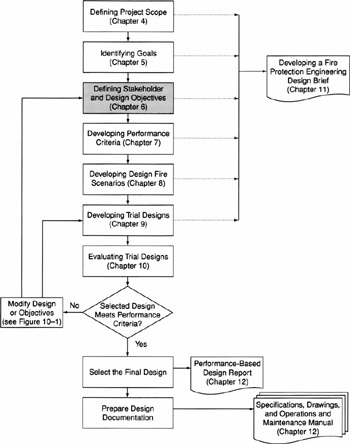
Once the fire protection goals have been established and agreed to, stakeholder objectives to meet the fire protection goals must be defined.
A stakeholder objective provides more detail than a fire protection goal, and it is often stated in terms of acceptable or sustainable loss or in terms of a desired (i.e., acceptable or tolerable) level of risk. Some stakeholders might, by virtue of experience or training, be able to state objectives in engineering terms that can serve as design objectives or performance criteria.
Stakeholder objectives might be stated broadly in terms of meeting one or more of the fundamental fire safety goals listed in 5.2. More specifically, objectives might be stated in terms of meeting the requirements of a specific code provision (prescriptive- or performance-based), of a specific insurance-related requirement, or in addition to a specific code or insurance provision or requirement.
Specific, project-related stakeholder objectives might reflect the maximum acceptable (tolerable) extent of injury to persons, damage to a building or its contents, damage to critical equipment or processes in the building, downtime or business interruption, risk ranking, or damage to the environment caused by fire or fire protection measures.
Stakeholder objectives might be expressed in different terms. For example, clients might express an acceptable loss as the maximum downtime or the amount of physical damage in dollars. Performance-based codes might state stakeholder objectives as an Objective, a...