SFPE Engineering Guide to Performance-Based Fire Protection Analysis and Design of Buildings

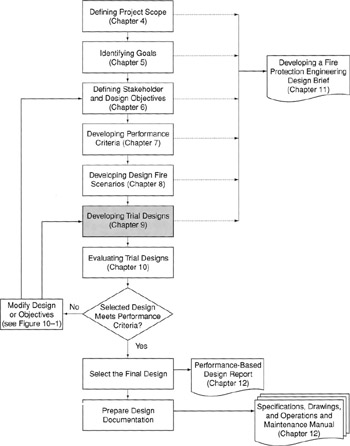
After the performance criteria have been established and the design fire scenarios have been determined, the next step is the development of trial designs. Design fire scenarios developed in Chapter 8 are used to test these trial designs, and the results of the analysis are evaluated (Chapter 10) using the performance criteria determined in Chapter 7.
When developing trial designs, the context in which the design will be evaluated should be considered. Trial designs can be evaluated at a subsystem level, which might involve a comparison with the provisions of a prescriptive-based design option, or on a system-performance or building-performance basis, which relies on an evaluation relative to established performance criteria.
Trial designs developed in the context of comparison evaluations might require a comparison of the performance of the design features of a prescriptive-based design option with the performance resulting from the trial design. Developing trial designs in this context might simply require selecting features similar to that of the prescriptive-based design option, but with enhanced capabilities or features. On the other hand, features might be selected that provide appropriate safeguards in a different manner. For example, in lieu of extinguishing a fire to mitigate a smoke hazard, venting could be used to purge the smoke hazard. Using prescribed features as a baseline for comparison, the evaluation could then demonstrate whether a trial design offers the same level of performance.
Trial designs evaluated...