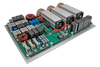
Help with Solid State Power Controllers (SSPC) specifications:
General Specifications
Back to Top

|
| ||
| SSPC Type | |||
| Your choices are... | |||
| AC Controller | AC controllers are designed to switch alternating current (AC) voltages. | ||
| DC Controller | DC controllers are designed to switch direct current (DC) voltages. | ||
| AC/DC Controller | AC/DC controllers are designed to switch both AC and DC voltages. | ||
| Analog | Analog controllers use variable voltage, current, or some other method of analog control. | ||
| Microcontroller based | Microcontrollers are complete computer systems on a chip. They typically combine an arithmetic logic unit (ALU), memory, timer/counters, serial port, input/output (I/O) ports, and clock oscillator. Microcontrollers require programming from external devices. | ||
| Programmable | Controllers can be programmed by a computer, or by a specialized or proprietary programming method. | ||
| Other | Other unlisted SSPC type. | ||
| Search Logic: | All products with ANY of the selected attributes will be returned as matches. Leaving all boxes unchecked will not limit the search criteria for this question; products with all attribute options will be returned as matches. | ||
| |||
| Mounting | |||
| Your choices are... | |||
| Bracket (Flange) Mount | The device is equipped with a flange that is installed typically by bolting the unit to a matching flange which is welded to a corresponding wall. | ||
| DIN Rail | The device is equipped with a fastener that can attach to a DIN rail. | ||
| Panel | The device can be mounted in or on a panel. | ||
| PC Board | The device can be mounted on or in a printed circuit board (PCB). | ||
| Socket or Plug-in Style | The device can be mounted in a socket or on a printed circuit board (PCB). | ||
| Other | Other unlisted mounting styles. | ||
| Search Logic: | All products with ANY of the selected attributes will be returned as matches. Leaving all boxes unchecked will not limit the search criteria for this question; products with all attribute options will be returned as matches. | ||
| |||
Performance
Back to Top
|
|
| ||
| Dropout Voltage | Dropout voltage (must-release voltage, turn-off voltage) is the voltage applied to the input at or below which the output enters the OFF state. Dropout voltage is also the noise-immunity level of the SSPC. | ||
| Search Logic: | User may specify either, both, or neither of the "At Least" and "No More Than" values. Products returned as matches will meet all specified criteria. | ||
| |||
| Input Channels | The maximum number of input channels. | ||
| Search Logic: | All matching products will have a value greater than or equal to the specified value. | ||
| |||
| Input Current Range | The range of input current at which the device is designed to operate. | ||
| Search Logic: | User may specify either, both, or neither of the "At Least" and "No More Than" values. Products returned as matches will meet all specified criteria. | ||
| |||
| Input (Pickup) Voltage Range | Input voltage (must operate voltage, pickup voltage, turn-on voltage) is the range of voltages which, when applied across the input terminals, maintains the ON condition across the output terminal. This defines the absolute limits of input voltage that the SSPC can withstand without damage. | ||
| Search Logic: | User may specify either, both, or neither of the "At Least" and "No More Than" values. Products returned as matches will meet all specified criteria. | ||
| |||
| Load Voltage | Load voltage (maximum switching voltage, line voltage) is the range of output supply voltages over which the SSPC normally operates. Typically, AC voltage is specified in root mean square (RMS) units. | ||
| Search Logic: | User may specify either, both, or neither of the "At Least" and "No More Than" values. Products returned as matches will meet all specified criteria. | ||
| |||
| Maximum Load Current | Maximum load current (maximum switching voltage range, maximum switching current) is the maximum continuous current allowed across SSPC output terminals under specified heat dissipation and ambient-temperature conditions. Typically, AC current is specified in root mean square (RMS) units. | ||
| Search Logic: | User may specify either, both, or neither of the "At Least" and "No More Than" values. Products returned as matches will meet all specified criteria. | ||
| |||
| Operating Temperature | The full-required range of ambient operating temperature. This represents the surrounding air temperature limits. | ||
| Search Logic: | User may specify either, both, or neither of the limits in a "From - To" range; when both are specified, matching products will cover entire range. Products returned as matches will meet all specified criteria. | ||
| |||
| Turn-on Switching | |||
| Your choices are... | |||
| Instant ON | Instant ON turns on the load immediately when the pickup voltage is present. Instant ON is used to control inductive loads. | ||
| Peak Switching | Peak switching turns on the load when the control voltage is present and the voltage is at peak. Peak switching is used to control heavy-duty inductive loads. | ||
| Random Turn-on | Random turn-on switching is used with inductive loads (transformers, etc.). | ||
| Zero Switching | Zero switching SSPCs switch when the AC load voltage or current passes through zero while changing polarity. Zero switching is used to control resistive loads. | ||
| Other | Other unlisted or proprietary turn-on switching method. | ||
| Search Logic: | All products with ANY of the selected attributes will be returned as matches. Leaving all boxes unchecked will not limit the search criteria for this question; products with all attribute options will be returned as matches. | ||
| |||
Additional Specs
Back to Top
|
|
| ||
| Construction | |||
| Your choices are... | |||
| Epoxy Shell | The device is constructed with an epoxy shell. | ||
| Plastic Mold Construction | The device is constructed with a plastic mold. | ||
| Other | Other unlisted construction. | ||
| Search Logic: | All products with ANY of the selected attributes will be returned as matches. Leaving all boxes unchecked will not limit the search criteria for this question; products with all attribute options will be returned as matches. | ||
| |||
| Output Device | |||
| Your choices are... | |||
| Bipolar Junction Transistor (BJT) | Bipolar junction transistors (BJT) are three-terminal devices in which the base current controls the current-collecting emitter. | ||
| MOSFET | Metal-oxide field-effect transistors (MOSFET) have an insulating layer between the gate electrode and the channel, a metal-oxide layer. | ||
| SCR | Silicon-controlled rectifiers (SCR) are three-terminal active devices which act as gated diodes. The gate terminal is used to turn on the device, allowing current to pass from cathode to anode. | ||
| Triac | Triacs are bi-directional, gate-controlled thyristors. They are similar to SCRs, but can conduct in both directions. Triacs provide full-wave control for AC power. | ||
| Other | Other unlisted output devices. | ||
| Search Logic: | All products with ANY of the selected attributes will be returned as matches. Leaving all boxes unchecked will not limit the search criteria for this question; products with all attribute options will be returned as matches. | ||
| |||
| Features | |||
| Your choices are... | |||
| Analog Switching | Devices have a built-in synchronizing circuit which controls the amount of output voltage as a function of the input voltage. Analog-switching is often used for resistive loads in closed-loop applications. | ||
| Bounce Free | Bounce-free devices turn on and off cleanly, without any spurious signals. | ||
| Built-in Heat Sink | The device has a built-in heat sink for thermal protection. | ||
| EMI Tolerant | The device is designed to withstand electromagnetic interference (EMI). | ||
| High Voltage Isolation | The device provides isolation from high voltages between the control and output circuitry. | ||
| Instant Trip Protection | Instant trip protection prevents the device from tripping because of very short duration events. | ||
| Internal Snubber | Internal snubbers absorb and suppress the overcurrent and resulting impulse noise caused by applying an above-rating voltage at the SSPC's output side. | ||
| Nuisance Trip Suppression | Nuisance trip suppression keeps the device from tripping due to small or false events. | ||
| Opto-Isolated | The control circuitry is isolated from the output by optical components. | ||
| Overcurrent Protection | The device has an integrated, overcurrent protection circuit. | ||
| Overvoltage Protection | The device has an integrated. overvoltage protection circuit. | ||
| Radiation Hardened | The device is designed to withstand radiation. | ||
| Reverse Protection | The device has circuitry to protect against reversing. | ||
| Soft Turn-on | The device slows the turn-on and turn-off stages to avoid sudden changes in current and voltage. | ||
| Thermal Memory | The device trips from a second, close-duration overload which occurs after an initial overload which failed to trip the circuit. | ||
| True I2t Protection | The device protects against thermal conditions in relation to both current and time. | ||
| TTL Compatible | The device can accept or produce transistor-transistor logic (TTL), or TTL-compatible signals. | ||
| Visual Indicator | The device has visual indicator such as light-emitting diodes (LED). | ||
| Other | Other unlisted or proprietary features. | ||
| Search Logic: | All products with ANY of the selected attributes will be returned as matches. Leaving all boxes unchecked will not limit the search criteria for this question; products with all attribute options will be returned as matches. | ||
| |||