
Opposing Screws Rigid Couplings
Last Updated: April 1, 2025
Description
Opposing Screws Rigid Couplings are mechanical devices used to connect two shafts together in a fixed position. They are designed to ensure that the shafts remain aligned and transmit torque without any relative motion between them. This type of coupling is characterized by its use of opposing screws to secure the shafts, providing a robust and reliable connection.
Working Principle
Opposing Screws Rigid Couplings work by clamping onto the shafts using screws that are positioned opposite each other. This configuration allows for a strong grip on the shafts, minimizing the risk of slippage. The rigid nature of these couplings means they do not accommodate any misalignment between the shafts, which is why precise alignment is crucial during installation. Their utility lies in their ability to provide high torque transmission and torsional stiffness, making them suitable for applications where precise shaft alignment is maintained.
Applications
Opposing Screws Rigid Couplings are commonly used in applications where precise alignment and high torque transmission are required. Specific examples include servo-driven applications in industries such as semiconductor manufacturing, medical equipment, packaging, and robotics. These couplings are also used in food equipment, where materials like 303 stainless steel are preferred for sanitized environments .
Advantages over other Rigid Couplings
One of the main advantages of Opposing Screws Rigid Couplings over other types of rigid couplings is their ability to provide a more secure and reliable connection due to the opposing screw configuration. This design can offer enhanced torque transmission and torsional stiffness compared to flexible couplings, which may not meet the performance requirements of certain high-demand applications .
Limitations
A significant limitation of Opposing Screws Rigid Couplings is their inability to accommodate any misalignment between the connected shafts. This means that precise alignment is essential during installation, and any misalignment can lead to increased wear or failure of the coupling. Additionally, the rigid nature of these couplings can result in higher stress on the shafts and connected components if misalignment occurs .
Considerations
When considering the use of Opposing Screws Rigid Couplings, it is important to factor in the initial costs, which may vary depending on the material and size of the coupling. Operating expenses are generally low, as these couplings do not require frequent maintenance. However, their durability and accuracy depend heavily on proper installation and alignment. Replacement and maintenance costs can be minimized by ensuring that the shafts are correctly aligned and that the coupling is installed according to manufacturer specifications. The choice of material, such as steel for high torque applications or stainless steel for corrosion resistance, can also impact the overall cost and performance .

from jbj Techniques Limited
This bolt coupling is a rigid shaft coupling. It is made of two halves, which are cast iron grade GG25 connected by means of bolts. It is maintenance and lubrication free. Additionally, its construction prevents fretting corrosion and allows for easy mounting and dismounting. The bolt coupling is... [See More]
- Design: Two Piece Clamping Style
- Features: Opposing Screws
- Units: English Design Arrangement; Metric Design Arrangement
- Material: Stainless Steel; Carbon / Alloy Steel; Aluminum
from John Crane, Inc.
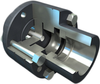
C series rigid couplings incorporate a segmented, piloted locating design. This eliminates the shaft distortion associated with conventional ‘clam shell ’ coupling designs where the motor shaft supports the pump shaft, and there are no bearings in the pump. It can also be used in... [See More]
- Design: 3-Piece Shrink Disc Clamping Style
- Features: Opposing Screws
- Bore 1: 10.5
- Material: Carbon / Alloy Steel
from Ruland Manufacturing Co., Inc.
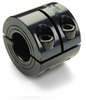
Features. Does not mar the shaft. Superior fit, finish and holding power. Opposing hardware for balance. Excellent for high axial loads. Transmit torque in confined spaces. Step bores available. Additional sizes available. RoHS2 and REACH Compliant. Width tolerance: +.003"/-.010". Bore tolerance:... [See More]
- Design: Two Piece Clamping Style
- Bore 1: 0.1250 to 2
- Units: English Design Arrangement
- O.D.: 0.6250 to 3