
Transient Power or Line Conditioners
Description
Transient power or line conditioners are devices designed to regulate and stabilize the voltage and current supplied to electrical equipment. They ensure that the power delivered is consistent and free from disturbances such as voltage spikes, sags, and harmonics, which can affect the performance and longevity of sensitive electronic devices.
Working Principle
Power conditioners work by filtering and adjusting the incoming electrical power to eliminate disturbances and maintain a stable output. They often incorporate components such as transformers, capacitors, and filters to smooth out voltage fluctuations and suppress electrical noise. This regulation is crucial for maintaining the integrity of the power supply, especially in environments where power quality issues are prevalent. By providing a stable and clean power supply, these conditioners help prevent damage to sensitive equipment and ensure optimal performance.
Applications
Power conditioners are widely used in environments where power quality is critical. Specific examples include:
- Medical Facilities: Ensuring stable power for life-supporting systems and sensitive medical equipment.
- Data Centers: Protecting servers and data storage systems from power disturbances that could lead to data loss or hardware damage.
- Industrial Processing: Maintaining consistent power for machinery and control systems to prevent operational disruptions.
- Telecommunications: Providing reliable power to communication equipment to avoid service interruptions.
Advantages over other Power or Line Conditioners
Compared to basic power protection devices, transient power conditioners offer superior voltage regulation and noise suppression. For instance, they can handle a wider range of voltage fluctuations and provide more comprehensive protection against power quality issues such as harmonics and transients, which are not typically addressed by simpler devices like basic surge protectors.
Limitations
One limitation of transient power conditioners is their inability to provide backup power during outages. Unlike Uninterruptible Power Supplies (UPS), they do not have battery storage to keep systems running during a complete power loss. Additionally, they may not be suitable for environments with extremely high power demands or where power quality issues are beyond their designed capacity to handle.
Considerations
When selecting a power conditioner, several factors should be considered:
- Initial Costs: The upfront investment can vary significantly depending on the capacity and features of the conditioner.
- Operating Expense: While generally low, operating costs can increase if the device requires frequent maintenance or if it is used in a high-demand environment.
- Durability: High-quality conditioners are built to withstand continuous use and harsh conditions, but their lifespan can be affected by the severity of the power disturbances they manage.
- Accuracy: The voltage regulation accuracy is crucial for ensuring that the output remains within the desired range, especially for sensitive equipment.
- Replacement and Maintenance Costs: Regular maintenance is necessary to ensure optimal performance, and replacement parts or units can add to the long-term costs.
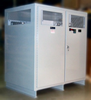
from Utility Systems Technologies, Inc.
The Sure-Volt ™ voltage regulator - power conditioner provides the broadest range of protection available to guard your valuable equipment and maximize your bottom line: Industry-leading overload capacity for compatibility with all loads types. Built-in surge suppression for surges and spikes. [See More]
- Protection: Harmonics (optional feature); Isolation; Line Noise; Short Circuit; Surge; Transient; Fault Clearing
- Input Voltage: 208
- Apparent Power Rating: 5000
- Output Voltage: 120 to 600

from Eaton | Power Quality
The EVR combines voltage regulation with a transformer and filter to remove transients and noise. The combined effect is regulating and shielded isolation transformer/system that solves 99 percent of the electrical disturbance problems, including electrical brownouts, sags, surges, transients and... [See More]
- Protection: Line Noise; Voltage Sags; Surge; Transient
- Output Voltage: 208 to 600
- Input Voltage: 208 to 600
- Phase: Three
from Eaton | Power Quality
The Eaton Power-Suppress 100 Ultra-Isolator Noise Suppressors protect sensitive equipment against electrical noise disturbances. Using exclusive double shielding techniques, the Power Suppress 100 blocks all forms of electrical noise including RFI/EMI, over a broad range of frequencies [See More]
- Protection: Isolation; Line Noise; Surge; Transient
- Input Voltage: 120 to 480
- Apparent Power Rating: 7.50E6
- Output Voltage: 120 to 240
from Eaton | Power Quality
The Eaton Power-Suppress T7 ultra-isolator noise suppressor protects electronic equipment in data rooms, wiring cabinets and other sensitive equipment against electrical noise disturbances. These impediments, from sources such as lighting, utility network switching and the operation of electric... [See More]
- Protection: Isolation; Line Noise; Lightning; Surge; Transient
- Input Voltage: 208 to 480
- Apparent Power Rating: 225000
- Output Voltage: 120 to 208
from Eaton | Power Quality
The Power-Sure 700 combines voltage regulation with a transformer and filter to remove transients and noise. The combined effect is regulating and shielded isolation transformer/system that solves 99 percent of the electrical disturbance problems, including electrical brownouts, sags, surges,... [See More]
- Protection: Isolation; Line Noise; Voltage Sags; Surge; Transient
- Input Voltage: 208 to 600
- Apparent Power Rating: 10000 to 300000
- Output Voltage: 208 to 480