
Alarm LED Digital Multimeters
Last Updated: April 1, 2025
Description
Alarm LED Digital Multimeters are advanced measuring instruments designed to provide precise readings of electrical parameters such as voltage, current, and resistance. These devices are equipped with alarm light-emitting diodes (LEDs) that activate when the measured values exceed predefined thresholds, alerting users to potential issues in the electrical system.
Working Principle
Alarm LED Digital Multimeters operate by using an integrated analog-to-digital converter to transform analog signals into digital data. This data is then processed to display accurate measurements on the device's screen. The alarm LEDs are triggered when the root mean square (RMS) or peak values surpass the set range, providing a visual alert to the user. This feature is particularly useful for monitoring and maintaining electrical systems, as it allows for immediate identification of abnormal conditions without constant supervision.
Applications
Alarm LED Digital Multimeters are used in various applications where monitoring electrical parameters is critical. For instance, they are employed in industrial settings to ensure machinery operates within safe electrical limits. They are also used in laboratories for testing and development purposes, where precise measurements are crucial for research and development. Additionally, these multimeters are valuable in the maintenance of electrical installations, helping technicians quickly identify and address issues.
Advantages over other Digital Multimeters
One of the primary advantages of Alarm LED Digital Multimeters over standard digital multimeters is their ability to provide immediate visual alerts through the alarm LEDs. This feature enhances safety and efficiency by allowing users to quickly respond to electrical anomalies. Furthermore, the integration of alarm LEDs reduces the need for constant monitoring, freeing up resources and personnel for other tasks.
Limitations
Despite their advantages, Alarm LED Digital Multimeters have limitations. The response time of the alarm LEDs may be slower compared to analog solutions, as the comparison of inputs to limits occurs in the digital domain after analog-to-digital conversion. This delay might be critical in applications requiring instantaneous response to electrical changes.
Considerations
When selecting an Alarm LED Digital Multimeter, several factors should be considered. Initial costs may be higher than standard digital multimeters due to the added alarm functionality. Operating expenses can vary based on the frequency of use and the need for calibration to maintain accuracy. Durability is generally high, but the device's lifespan can be affected by environmental conditions and handling. Accuracy is a key consideration, as precise measurements are essential for effective monitoring. Replacement and maintenance costs should also be evaluated, as regular servicing may be required to ensure optimal performance.

from OMEGA Engineering, Inc.
The HHM8229 meter is a portable professional measuring instrument with large LCD to show three lines of readings, as well as a backlight for easy reading. The “single-hand operation ” design for the range switch makes measurement simple and easy. Overload protection and low battery... [See More]
- Options & Features: Has Alarm LED; Auto-ranging; Battery powered; dB readings; Overload Protection; Range Switch
- Measurement Type: AC / DC
- Form Factor: Handheld
- DC Voltage: 0.4000 to 1000
from REED-Direct
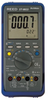
Safety warning: Audible and visual alarms alert user if test lead connections do not match function selected. Continuity test and diode check. High contrast 4000-count LCD with backlight. Data hold and Auto shut off. CAT III 1000V. Includes type K temperature probe, test leads, soft carrying case... [See More]
- Options & Features: Has Alarm LED
- Measurement Type: AC / DC
- Form Factor: Handheld
- DC Voltage: 0.0 to 1000