
25° Worms and Worm Gears
Description
25° Worms and Worm Gears are mechanical components used in gear systems to transmit motion and power between non-parallel shafts. They consist of a worm, which is a helical threaded shaft, and a worm gear, which is a cylindrical gear that meshes with the worm. This configuration allows for the conversion of rotational motion and torque between the two components.
Working Principle
The working principle of worm gears involves the meshing of the worm and the worm gear to achieve a reduction in speed. The worm's helical threads engage with the teeth of the worm gear, causing the worm gear to rotate at a reduced speed compared to the worm. This reduction in speed is accompanied by an increase in torque, making worm gears particularly useful for applications requiring high torque output at low speeds. The unique design of worm gears also provides a self-locking feature at certain gear ratios, preventing reverse motion and enhancing stability in load-bearing applications .
Applications
Worm gears are widely used in various industries due to their ability to provide high torque and low-speed output. Specific applications include:
- Lifting mechanisms in elevators and hoists, where the high torque and self-locking capabilities are advantageous.
- Conveyor systems in manufacturing plants, where precise control of speed and direction is required.
- Automotive steering systems, where compact design and quiet operation are essential .
Advantages over other Worms and Worm Gears
25° Worms and Worm Gears offer several advantages over other types of gear systems:
- They provide a high reduction ratio in a compact design, making them suitable for space-constrained applications.
- The self-locking feature at certain gear ratios enhances safety by preventing back-driving, which is not typically available in other gear systems.
- They operate quietly, which is beneficial in noise-sensitive environments .
Limitations
Despite their advantages, worm gears have some limitations:
- They generally have lower mechanical efficiency compared to other gear types, such as spur or bevel gears.
- The self-locking feature, while beneficial in some applications, can be a limitation in systems where reversibility is required.
- Worm gears can experience higher wear and tear due to the sliding contact between the worm and the gear, necessitating regular maintenance .
Considerations
When selecting and using 25° Worms and Worm Gears, several factors should be considered:
- Initial costs are generally lower compared to other gear systems, but the long-term operating expenses can be higher due to maintenance needs.
- Proper lubrication is essential to minimize wear and extend the lifespan of the gears.
- The durability of worm gears is high, but regular inspection and maintenance are necessary to ensure accuracy and performance.
- Replacement and maintenance costs should be factored into the overall cost of ownership, as these can vary depending on the application and operating conditions .
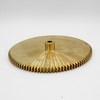
from W.M. Berg
Best choice of gearing when high drive reduction is required. Worm Wheels resemble spur gears with the addition of a throat cut into the O.D. of wheel. The throat permits the worm wheel to fully envelope the threads of the worm. Threads, not teeth are cut on the worm, and by adjusting the number of... [See More]
- Pressure Angle: 25°
- Length: 0.44
- Gear Type: Worm
- Material: Bronze
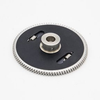
from W.M. Berg
Anti-Backlash Gears are gears having minimum or no backlash (play). Anti-backlash capabilities can be applied to many types of gears, and is most commonly seen in spur gears, bevel gears, miter gears, and worm gears. Sometimes backlash is a favorable and necessary part of the way gears work, but in... [See More]
- Pressure Angle: 25°
- PD: 1.50
- Gear Type: Worm
- Length: 0.44

from W.M. Berg
Best choice of gearing when high drive reduction is required. Worm Wheels resemble spur gears with the addition of a throat cut into the O.D. of wheel. The throat permits the worm wheel to fully envelope the threads of the worm. Threads, not teeth are cut on the worm, and by adjusting the number of... [See More]
- Pressure Angle: 25°
- PD: 0.50
- Gear Type: Worm
- OD: 0.5830