
Encoder Digital Timers
Description
Encoder digital timers are devices designed to measure and control time intervals with high precision. They are typically used to start, stop, or delay operations based on a pre-set time. These timers can be programmed to count up or down, providing flexibility in timing operations.
Working Principle
Encoder digital timers operate by using a combination of counting and timing functions. They often incorporate an oscillator, either built into the system or external, to generate a stable time base. The timer counts the oscillations to measure elapsed time. This precise counting mechanism allows for accurate timing intervals, making them useful in applications where timing precision is critical. The ability to program these timers to start, stop, or reset based on specific conditions enhances their utility in automated systems.
Applications
Encoder digital timers are widely used in industrial process control, where precise timing is essential for operations such as conveyor belt movement, robotic arm control, and other automated manufacturing processes. They are also employed in consumer electronics for functions like setting alarms or controlling the duration of appliance operations.
Advantages over other Digital Timers
Encoder digital timers offer superior precision and flexibility compared to other digital timers. Their ability to count both up and down allows for more complex timing operations. Additionally, the use of oscillators provides a stable time base, reducing the uncertainty in timing intervals that can occur with software-based timers.
Limitations
One limitation of encoder digital timers is their reliance on oscillators, which can introduce errors if not properly calibrated. Additionally, the complexity of programming these timers can be a barrier for users without technical expertise.
Considerations
When selecting encoder digital timers, consider the initial cost, which can be higher due to their advanced features. Operating expenses are generally low, but maintenance costs can vary depending on the environment in which they are used. Durability is typically high, but accuracy can be affected by external factors such as temperature fluctuations. Replacement and maintenance costs should also be factored in, especially in harsh industrial environments where wear and tear can be significant.
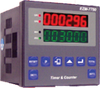
from Hoyt Electrical Instrument Works, Inc.
SHAFT ROTATION monitors, frequently called ZERO SPEED or TACHOMETER relays operate when the pulses (usually generated by a proximity switch) received fall below a user selected set point. This situation is sometimes caused by something jamming the machine. The motor(s) draws excessive current thus... [See More]
- Sensor & Specialized Inputs: Encoder; Dry Contact, Inductive or Capacitive Sensor
- Technology: Electronic
- Instrument Type: Counter; Timer; Counter / Timer Combination
- Number of Functions: Multi

from Specialty Product Technologies
The C628 Elapsed Timer is a member of a family of 1/8 DIN instruments which offer breakthrough display technology as well as easy-to-program user setup. Its large LED display features the ability to change color based on process status such as exceeding the preset value. [See More]
- Sensor & Specialized Inputs: Encoder; Switch; Magnetic
- Technology: Electronic
- Instrument Type: Timer
- Direction: Up Count

from Specialty Product Technologies
The MAX Jr. Series provides the flexibility needed for the most demanding item counting and length measurement applications. Its bidirectional operation, high contrast display with polarity indicator, and reference preset function make it especially well-suited for use as a low cost position... [See More]
- Sensor & Specialized Inputs: Encoder; Switch; Magnetic
- Technology: Electronic
- Instrument Type: Timer
- Functions: Ratemeters (Tachometers)