
-
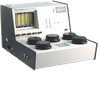
Supplier: Quantachrome Instruments
Description: The Pentapyc 5200e and the Ultrapyc 1200e are the ultimate gas pycnometers for measuring the true density and volume of powders, catalysts, pharmaceuticals, ceramics, carbons, building materials, rock core plugs, etc. The Pentapyc 5200e gas pycnometer permits up to five
- Specimen Cell Volume Range: 10 to 135 cc
- Display & Special Features: Computer Interface / Networkable, Data Storage Options, Laboratory Style (Benchtop or Handheld)
- Features: Density Instruments, Pycnometer
- Technology Type: Digital Instrument
-
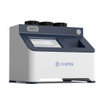
Supplier: CIQTEK Co., Ltd
Description: EASY-G 1310 is a high-precision gas pycnometer independently developed by CIQTEK, which adopts the gas displacement method. It is favored by users for its high integration, compact size, lightweight, and high-cost performance due to the multi-sample container design. Several
- Properties Analyzed: Adsorption / Desorption (Chemisorption/ Physisorption)
- Test Media: Chemicals, Food / Drugs, Powders / Granular Materials, Soil
- Features: Other
-
Supplier: Quantachrome Instruments
Description: and wicking. The standard technique used by the Foam pycnometers is that of gas expansion from a calibrated sample chamber into a reference volume. The solid and closed cell volume of the sample is calculated from the relationship of the calibrated cell volumes and the pressures before
- Pressure Range: 2 to 18 psi
- Specimen Cell Volume Range: 10 to 135 cc
- Display & Special Features: Computer Interface / Networkable, Data Storage Options, Laboratory Style (Benchtop or Handheld)
- Features: Density Instruments, Pycnometer
-
-
Supplier: Accuris
Description: Standard Test Method for Specific Gravity of Soil Solids by Gas Pycnometer
-
Supplier: Accuris
Description: Method for Density Determination of Metal Injection Molded (MIM) Components Using a Gas Pycnometer
-
Supplier: Accuris
Description: STANDARD TEST METHOD FOR SPECIFIC GRAVITY OF SOIL SOLIDS BY GAS PYCNOMETER - INCLUDES STANDARD + REDLINE (PDF)
-
Supplier: ASTM International
Description: 1.1 This test method covers the determination of the specific gravity of soil solids by means of a gas pycnometer. Particle size is limited by the dimensions of the specimen container of the particular pycnometer being used. 1.2 Test Method D854 may be used instead of or in
-
Supplier: Accuris
Description: Standard Test Method for True Specific Gravity of Refractory Materials by Gas-Comparison Pycnometer
-
Supplier: ASTM International
Description: can be obtained via liquid displacement. 1.2 The technique will provide results under the following constraints: 1.2.1 The stability of the helium gas pycnometer is greater than \u00b10.005 cm3 1.2.2 Test specimen weights are greater than 1 g. 1.3 The values stated in inch-pound units
-
Supplier: ASTM International
Description: 1.1 This test method covers the determination of the true specific gravity of solid materials, and is particularly useful for materials that easily hydrate which are not suitable for test with Test Method C 135. This test method may be used as an alternate for Test Method C 135, Test Method C 128,
-
Supplier: CSA Group
Description: ISO 18753:2017 specifies a method for determining the absolute particle density of fine ceramic powders or sintered parts using liquid pycnometry. NOTE Other pycnometer methods like gas pycnometers (e.g. helium pycnometer), where a gas is used as media, also exist.
-
Supplier: Micromeritics
Description: he AccuPyc II 1340 Series Pycnometers are fast, fully automatic pycnometers that provide high-speed, high-precision volume measurements and density calculations on a wide variety of powders, solids, and slurrie shaving volumes from 0.01 to 350 cm3. The instrument completes most sample
- Specimen Cell Volume Range: 1 to 350 cc
- Features: Density Instruments, Other, Pycnometer
- Technology Type: Digital Instrument
- Display & Special Features: Laboratory Style (Benchtop or Handheld)
-
Supplier: CSA Group
Description: ISO 12154:2014 specifies a method for rapid and efficient determination of the skeleton density of solid material samples of regular or irregular shape, whether powdered or in one piece, by means of a gas displacement pycnometer.
-
Supplier: AENOR
Description: Coating powders - Part 2: Determination of density by gas comparison pycnometer (referee method) (ISO 8130-2:2021)
-
Supplier: CSA Group
Description: displacement and a pycnometer method by gas displacement. The fluid pycnometer method described in this part of ISO 17892 applies to soil types with particle sizes under about 4 mm, or soils crushed to meet this requirement. Larger pycnometers are used for coarser
-
Supplier: ASTM International
Description: This method is for determining true density of powders and solids by displacement of helium gas. This method is written for use with a Micromeritics AccuPyc 1330 Pycnometer; however, equivalent equipment may be used.





Find Suppliers by Category Top
More Information Top
 Indicates content that may require registration and/or purchase.

-
An experimental comparison of laboratory techniques in determining bulk properties of tuffaceous rocks; Yucca Mountain Site Characterization Project
to those arrived at with the gas pycnometer .
-
http://repository.up.ac.za/bitstream/handle/2263/25884/00dissertation.pdf?sequence=1
The first method is a gas pycnometer , which is almost exclusively used by laboratories.
-
Determination of bulk density, methods and impacts, with a case study from Los Bronces Mine, Chile†
Anglo American Platinum operations and projects in South Africa use two methods to determine density, namely, the helium gas pycnometer method for pulps, and the hydrostatic immersion (Archimedes) method for drill core.
-
Pore formation in apple during air‐drying as a function of temperature: porosity and pore‐size distribution
Abstract Characteristics of air‐dried apple produced by drying at 50, 80 and 105 °C were studied by measuring apparent porosity, open pore porosity and pore‐size distribution with a helium gas pycnometer and mercury porosimetry.