
-
Supplier: Thorlabs, Inc.
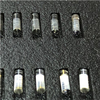
Description: provides an 8° or 0° face angle that is designed to match the GRIN lenses. GRIN lenses do not require an air gap to function since the operation of the lens is due to varying indices in the lens itself, rather than the difference in indices between the air and
- Focal Length: 1.85 to 1.99 mm
- Diameter / Length: 1.8 mm
- Center Thickness: 4.260000000000001 to 5.59 mm
- Lens Features: Antireflection Coating
-
Supplier: Changchun Sunday Optics Co., Ltd.
Description: High-quality laser diode,optical glass lens, driver circuit and housingBetter line quality
- Lens Features: Antireflection Coating
-
Supplier: Newport MKS
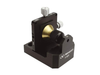
Description: The 466A-734 Grin Lens Holder has a 4 mm long reversible V-block. It holds GRIN lenses 1 to 2 mm or 2 to 3 mm in diameter. Compatible with the 466A Series Flexure Stages.
-
-
Supplier: Newport MKS
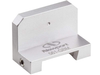
Description: The 561-GBM Blank GRIN lens mount can be machined to create custom component holders to mount on the 561/562 rail.
-
Supplier: Newport MKS
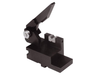
Description: The F-925 GRIN Lens Fiber Coupler provides a convenient means of aligning fibers with GRIN lenses to obtain efficient laser-fiber coupling and output collimation in a compact space. The Model F-925 is designed for bare fibers. Optimal coupling efficiency is achieved with
- Stroke or X-Axis Travel: 0.06299216 inch
- Y-Axis Travel: 0.06299216 inch
- Z-Axis Travel: 0.14173236 inch
- Axis Configuration: X-Y-Z Axes
-
Supplier: Newport MKS
Description: The F-926 GRIN Lens Fiber Coupler provides a convenient means of aligning fibers with GRIN lenses to obtain efficient laser-fiber coupling and output collimation in a compact space. The Model F-926 has the ability to rotate the chuck to align a bare polarization-preserving fiber
- Stroke or X-Axis Travel: 0.06299216 inch
- Y-Axis Travel: 0.06299216 inch
- Z-Axis Travel: 0.14173236 inch
- Axis Configuration: X-Y-Z Axes
-
Supplier: Edmund Optics Inc.
Description: Ideal for Fiber Coupling and Laser Diode Beam Shaping Comparable Performance to Conventional Aspherical Singlets 3 Sizes and 3 Wavelength Options Gradient Index (GRIN) lenses feature plane optical surfaces and achieve focus via a continuous change of the refractive index within the
- Diameter / Length: 0.5 mm
- Surface Quality: 40-20 Scratch / Dig
- Lens Type: Aspheric Lens
- Features: Other
-
Supplier: Edmund Optics Inc.
Description: Ideal for Fiber Coupling and Laser Diode Beam Shaping Comparable Performance to Conventional Aspherical Singlets 3 Sizes and 3 Wavelength Options Gradient Index (GRIN) lenses feature plane optical surfaces and achieve focus via a continuous change of the refractive index within the
- Diameter / Length: 1.8 mm
- Surface Quality: 40-20 Scratch / Dig
- Lens Type: Aspheric Lens
- Features: Other
-
Supplier: Edmund Optics Inc.
Description: Ideal for Fiber Coupling and Laser Diode Beam Shaping Comparable Performance to Conventional Aspherical Singlets 3 Sizes and 3 Wavelength Options Gradient Index (GRIN) lenses feature plane optical surfaces and achieve focus via a continuous change of the refractive index within the
- Diameter / Length: 1.8 mm
- Surface Quality: 40-20 Scratch / Dig
- Lens Type: Aspheric Lens
- Features: Other
-
Supplier: Edmund Optics Inc.
Description: Ideal for Fiber Coupling and Laser Diode Beam Shaping Comparable Performance to Conventional Aspherical Singlets 3 Sizes and 3 Wavelength Options Gradient Index (GRIN) lenses feature plane optical surfaces and achieve focus via a continuous change of the refractive index within the
- Diameter / Length: 1.8 mm
- Surface Quality: 40-20 Scratch / Dig
- Lens Type: Aspheric Lens
- Features: Other
-
Supplier: Changchun Sunday Optics Co., Ltd.
Description: GRIN lenses are used to focus and collimate light within a variety of fiber optic components. GRIN lenses , short gradient index,focus light through a precisely controlled radial varition of the lens material index of refraction from the optical axis to the edge of the
- Diameter / Length: 3 to 280 mm
- Surface Flatness: λ/10
- Surface Quality: 40-20 Scratch / Dig
-
Supplier: SPIE - Education
Description: Gradient index (GRIN) lenses are more common than you may know. The human lens is a gradient index optic, and the last time you scanned a document the scanner probably used a gradient index lens array. In a homogeneous lens, light refracts at the surfaces, only bending
- Type: Course
- Technology / Subject Expertise: Design / Engineering Methods (ESDU, DFx, etc.), Photonics / Optics
- Delivery: On-site / In Plant
-
Supplier: SPIE
Description: The use of diffractive and gradient-index (GRIN) lenses as components of imaging optical systems has been investigated for several decades. The elements have proved competitive in their unique focusing and aberration properties and in terms of their additional degrees of freedom for optical
-
Supplier: Safety Glasses USA
Description: golfers. This golf optimized edition of FLAK JACKET is available in two lens shape options: standard lens size or the larger XLJ shape with extended coverage. If you decide to add optional lenses later, remember that both lens sizes fit the frame, and all FLAK JACKET lens





Find Suppliers by Category Top
More Information Top
 Indicates content that may require registration and/or purchase.

-
http://dspace.mit.edu/bitstream/handle/1721.1/30248/60822242-MIT.pdf?sequence=2
Gradient-Index ( GRIN ) Lenses by Slurry-Based Three-Dimensional Printing .
-
http://aran.library.nuigalway.ie/xmlui/bitstream/handle/10379/3463/Mehdi.pdf?sequence=1
Geometry-invariant GRIN lens : iso-dispersive contours .
-
http://dspace.mit.edu/bitstream/handle/1721.1/42919/247993079-MIT.pdf?sequence=2
MINIATURIZED TPE ENDOMICROSCOPY THAT UTILIZE GRIN LENSES (B AND C)..............................................118 .
-
Characteristics Of Single-Mode Fiber Components Using GRIN Rod Lenses
Since misalignments occur at the joint of the two GRIN lenses , it is appropriate to choose the end face of the GRIN - rod lens on the right as Rf.
-
Polymeric nanolayered gradient refractive index lenses: technology review and introduction of spherical gradient refractive index ball lenses
A nanolayered polymer films approach to designing and fabri- cating gradient refractive index ( GRIN ) lenses with designer refractive index distribution profiles and an independently prescribed lens surface geometry have been demonstrated to produce a new class of optics.
-
Three-dimensional large-aperture lens antennas with gradient refractive index
Using the same method, we design and realize a huge-aperture GRIN lens in the X band with a diameter of 1000 mm, which is composed of nearly one millions of inhomogeneous unit cells of square-ring resonators and dielectric blocks with …
-
http://dspace.mit.edu/bitstream/handle/1721.1/57696/648772473-MIT.pdf?sequence=2
The compound system is constrained to a maximum thickness of 5mm and utilizes an optically recorded hologram for correct- ing high-order optical aberrations of the GRIN lens array.
-
Further analysis of focusing performance of an ultra-small gradient-index fiber probe
A gradient-index ( GRIN ) lens probe, which has a broad pros- pect for a variety of miniaturized OCT system since it is easy to be integrated into an endoscopic environment, has been investigated by researchers in recent years.
-
Analytical method for designing gradient-index fiber probes
Among the miniaturized probes, a gradient-index ( GRIN ) lens is promising since it is easy to be integrated into an endoscopic environment.
-
Fiber array optical-coupling design issues for photonic beam formers
In section 3, single-mode fiber coupling efficiency with GRIN rod lenses is studied in terms of lateral, angular, and separation misalignment of the fiber-optic GRIN lens assembly.