
-
Supplier: Acrolab Ltd.
Description: including injection, compression, transfer, vacuum form, pour cast, die cast, and extrusion molding, insulation spray guns, and masks. Stoner E236 Urethane Mold Release Features & Benefits Saves time - lets urethane parts release quickly and easily from
- Features: Aerosol / Spray
- Industry Applications: Food Grade / Contact (FDA H1)
-
Supplier: Guardair Corporation
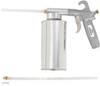
Description: plastic spray nozzles Spray oils, solvents, cleaners, disinfectants, insecticides, mold release agents and coatings Meets OSHA standards Conforms to MIL-G-952 type 1 Durable cast aluminum body 1/4" FNPT inlet Syphon Spray Gun High vacuum syphon delivers up
-
Supplier: Guardair Corporation
Description: Features High vacuum syphon delivers up to 12 gallons per hour Separate liquid and air controls provide user with optimum flexibility Includes a six (6) foot syphon hose with sinker Spray oils, solvents, cleaners, disinfectants, insecticides, mold release agents and coatings
-
-
Supplier: Henkel Corporation - Industrial
Description: Water-based mould release emulsion whose high slip properties make it ideal for difficult-to-release rubbers and especially highly abrasive compounds. LOCTITE® FREKOTE R180 is a water-based mould release emulsion whose high slip properties make it ideal for
- Operating / Use Temperature: 140 to 401 F
- Features: Specialty
-
Supplier: Techsil Limited
Description: BJB RF-5215 is a water-soluble parting film (PVA) recommended for separation between polyester, epoxy and polyurethane resins from various mold surfaces. It is typically applied by a siphon cup spray gun, but can also be brushed or painted on. After the part has been separated




Find Suppliers by Category Top
Featured Products Top
-
 SAMES Inc. would like to announce the release of the new Xcite™ Light Airmix® Manual Spray Gun. The Xcite™ Light Airmix® Manual spray gun is available in two models: 60 bar (870 psi) and 120 bar (1740 psi). The new Xcite Light (read more)
Browse Spray Guns and Applicators Datasheets for Sames North American Corporation -
SAMES would like to announce the release of the new Airspray Tanks. The new Airspray Tanks offer multiple solutions to match a variety of needs: Capacity from 2L to 50L Maximum pressure from 3.5 Bar to 7.0 Bar (read more)
Browse Spray Tanks and Cups Datasheets for Sames North American Corporation -
offer a simple approach for the customer to order a ready-to-spray solution including all our new Airspray products (FPro spray guns, new air and fluid hoses, and new Airspray Tanks) to gain all the benefits from SAMES’s breakthrough technology in products and solutions. (read more)
Browse Spray Tanks and Cups Datasheets for Sames North American Corporation -
. Spray-up molding is similar to the hand lay-up method, though it uses a chopper gun and other special equipment to cut reinforcing material into shorter fibers before adding it to the resin mixture on the mold’s surface. As it involves automation, this (read more)
Browse Mold Making Services Datasheets for Osborne Industries, Inc. -
different properties. MoS2 provides higher load carrying and corrosion protection than graphite, while graphite provides higher temperature stability and better electrical conductivity. PTFE provides the highest level of corrosion protection, release, and functionality for lighter load applications (read more)
Browse Solid and Dry Film Lubricants Datasheets for Everlube Products -
protection than graphite, while graphite provides higher temperature stability and better electrical conductivity. PTFE provides the highest level of corrosion protection, release, and functionality for lighter load applications. 3. How do solid film lubricants produce low friction? (read more)
Browse Industrial Lubricants Datasheets for Everlube Products -
different properties. MoS2 provides higher load carrying and corrosion protection than graphite, while graphite provides higher temperature stability and better electrical conductivity. PTFE provides the highest level of corrosion protection, release, and functionality for lighter load applications (read more)
Browse Industrial Coatings Datasheets for Everlube Products -
reference minimum applicable load of 1 mA at 5 VDC. A one-piece insert-molded terminal structure helps prevent solder flux from traveling into the switch during board or wire assembly. This feature improves manufacturing reliability, but the IP40 enclosure is (read more)
Browse Electromechanical Relays Datasheets for ERSAELECTRONICS PTE. LTD.
More Information Top
 Indicates content that may require registration and/or purchase.

-
Effect of Structure on the Mechanical Behaviors of Three-Dimensional Spacer Fabric Composites
About 30% resin was first applied evenly by means of a spray gun on the mold with releasing agent coated surface, and then the fabric was placed over it with warp direction parallel to the longitudinal direction of the cushion block.
-
Robotic Oiling Of Concrete Moulds Cuts Wastage
The arm carrying an electrostatic spray gun descends into the car and applies mould release oil smoothly and evenly to the inner surfaces.
-
Testing epoxy composite surfaces for bondability
Grit blasting was more efficient than abrasion but was still not able to remove the very thick layer of PTFE transferred from R4 mould release spray : three passes of the grit blast gun still left 30% PTFE on the surface.
-
Kanerva's Occupational Dermatology
Before beginning the lamination of a plastic boat hull, the mold is treated by hand or by spray gun with release agents and a pigmented, thermosetting coating resin, known as gel coat.
-
The Direct Effects of Lightning on Aircraft
A coating between 4 and 6 mils thick is usually applied, and it may be sprayed into the mold prior to layup of the composite part, or applied with a spray gun after the part has been released from the mold .
-
Polymer Technology
In the actual process the mold is first coated with a release agent and then a gel coat is applied by hand or spray - gun .
-
Polyester Resins, Unsaturated
For contact-molding methods, including hand lay-up and spray-up, the surface of the open mold is first treated with a release agent, such as a wax, followed by a gel coat that is applied with a spray gun .
-
Limit analysis on surface roughness and dimensional accuracy of spray metallic crust for rapid tooling production by metal arc spraying process
Although reverse flow of mould release agent likely creates undulation on innermost spray surface (Fig. 7a), its severity is only markedly revealed at low travel speed of spray gun (Figs. 7a and b) [23].
-
Encyclopedia of Plastics, Polymers, and Resins Volume 3
… P-4 and P-6 powders to improve flow properties of highly-filled PPS compounds; V-I can be cured and then used as a compression molding resin; offers excellent affinity … … using most standard industrial spray guns ; release coatings can be made …
-
First aid - chemistry and physics for physicians
… 397 electron rejection 371 electron affinity 439, free 360 electronegativity 353-scale and tendencies in the PSE 438 electron delivery versus receiving, electron acceptor … … electron gas 373 electron gun 269, redox equation, complex … … electro phil 495 electro spray ionization (ESI) 584 electrostatic … 617-demarcation epimer 515-Glyceraldehyd 515-complexes 554 501, SN1 reaction, endergonisch 416 413 endothermic Energetik versus kinetics 411 forms - of -energy 102-Gibbs free 416, interior 103 mechanism 101, usable 106, energy diagram 427 Energiedosis(leistung) 339 energy conservation 104 law …