
RFID Transceivers Information
RFID transceivers establish RFID reception and transmission on the same integrated circuit. This allows them to reprogram RFID tags.
RFID transceivers function similarly to RFID readers. These devices emit a particular radio frequency signal which is perceived by an RFID tag. If the tag is programmed to a compliant frequency, it will emit a return RF signal which  includes the tag's protocol, managing organization, asset description, and serial number. Transceivers are typically cabled to a programmable logic controller (PLC) or computer via an IO module. If the module is programmable, it can be used to provide more comprehensive data to the PLC or computer; the PLC or computer then instructs the RFID transceiver to recode or rewrite the tag if necessary.
Many tags are programmed with protocol, encryption, or a read/write mode which cannot be changed. This prevents the tag from corruption and unauthorized interrogating. Some tags allow these specifications to be changed, in which case the RFID transceiver is capable of rewriting the tag's functionality. Since tag frequency is directly related to antenna geometry, frequency cannot be changed but modulation depth is adjustable. One of the chief advantages of an RFID transceiver is the time saved; a module is able to read and rewrite a tag with only one input from the operator.
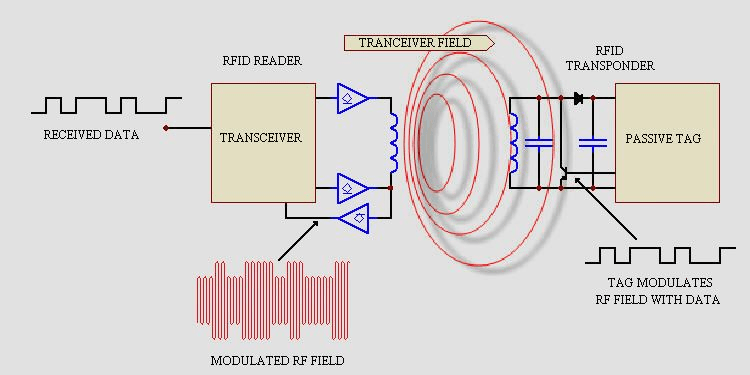
RFID transceivers are common when RFID tag codes needs frequent changes. If used in conjunction with encoded software, customized and secure RFID tags can be made. Since the transceiver is capable of reception and transmission, RFID connections which use transceivers have better encryption than those which use RFID readers and tags. The applicable range of the transceiver is often limited to within several inches as a feature, not a design constraint.
Frequencies
The accompanying table represents the most common frequencies used by RFID equipment.
| Band | Range | Data speed | Common uses |
| 120—159 kHz (low frequency) | 10 cm | Low | Animal identification; factory data collection; auto keys |
| 13.56 MHz (high frequency) | 10 cm—1 m | Low to moderate | Smart cards; shelf inventories; transactions |
| 433 MHz (ultra-high frequency) | 1—100 m | Moderate | Defense applications; tracking pallets |
|
Eurasia: 865—868 MHz (ultra-high frequency) North America: 902—928 MHz (ultra-high frequency) |
1—12 m | Moderate to high | Inventory; hard-to-read RFID applications |
| 2450—6800 MHz (microwave) | 1—2 m | High | 802.11 WLAN, Bluetooth standards |
| 3.1—10 GHz (microwave) | >200 m | High | Road toll accounts |
NFC (Near Field Communication)
NFC, or near field communication, is a short range subset of radio-frequency identification (RFID) communication protocols that use electromagnetic radio fields for connecting electronic devices. NFC enabled devices maybe passive or active with passive devices allowing only reading from other devices while active can read and send information. NFC operates at 13.56 MHz at a distance of 4 cm and has a data transfer rate up to 424 kbps. It is used in the consumer electronics industry allowing users to connect to other NFC enabled devices without compromising personal data.
Standards
RFID systems are often regulated by industry standards as a whole, and not by individual components. Some of the more notable standards include the following.
ISO 14443 RFID use in passports and ID cards
BS ISO 29143 Automatic identification and data capture
ISO 17366 RFID use for produce packaging
Transceiver Applications
Applications in which the flexibility of RFID transceivers is useful include:
- Access control
- User identifications
- Robotic navigations
- Inventory and product tracking
- Payment systems
- Automobile immobilization
- Various types of automated manufacturing
Resources
RFID basics by Priority 1 Design
Parallax RFID Read/Write Module Serial 28440, datasheet (.pdf)
Image credits:
Turck USA | Priority 1 Design


