
RFID Readers Information
RFID tags assign a unique electronic identity to a physical article; an RFID reader decodes the information contained in the tag. These two devices exchange information by the use of short-range RF signals.
RFID tags provide the assets with an electronic identity that can be encoded and read by RFID readers. The RFID reader propagates a particular radio frequency. Once a compatible RFID tag enters the reader's detection range, the tag transmits a return signal. This return signal has been modulated to include the tag's protocol, managing organization, asset description, and serial number. Such information is commonly stored as a 96-bit string of data called an electronic product code (EPC). The reader uses an error-correcting code algorithm to determine EPC accuracy. At this point the reader relays the tag identification to the system user, server, or database, which updates the data of the RFID tag as needed.
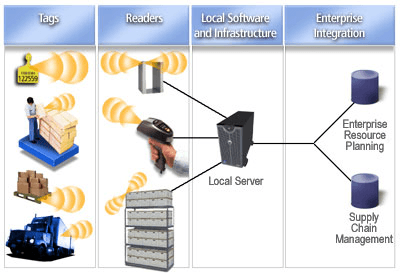
Image credit: Advanced Infrastructure
The way in which the reader perceives the RFID tag depends on whether the tag is active or passive. Active tags periodically transmit the tag's RF signal, which the reader registers. Active tags require a charge in the circuit and antenna; the integrated battery gives them a larger range. Semi-active (the circuit is charged, but not the antenna) or passive (there is no battery and no charge) RFID tags wait to receive the initial RF from the reader before broadcasting the return signal. Since passive tags have no battery to charge the circuit, the initial magnetic field radiated by the reader must be three times the field needed to maintain communication. Readers compatible with passive tags require a larger, in-phase coil antenna as well.
Frequencies
The accompanying table represents the most common frequencies used by RFID equipment.
| Band | Range | Data speed | Common uses |
| 120—159 kHz (low frequency) | 10 cm | Low | Animal identification; factory data collection; auto keys |
| 13.56 MHz (high frequency) | 10 cm—1 m | Low to moderate | Smart cards; shelf inventories; transactions |
| 433 MHz (ultra-high frequency) | 1—100 m | Moderate | Defense applications; tracking pallets |
|
Eurasia: 865—868 MHz (ultra-high frequency) North America: 902—928 MHz (ultra-high frequency) |
1—12 m | Moderate to high | Inventory; hard-to-read RFID applications |
| 2450—6800 MHz (microwave) | 1—2 m | High | 802.11 WLAN, Bluetooth standards |
| 3.1—10 GHz (microwave) | >200 m | High | Road toll accounts |
Bulk Reading
An RFID reader will frequently sense multiple RFID tags within its detection range. Readers must read each tag sequentially in order to comprehend each individual identity. Readers which are expected to bulk read must be programmed with collision detection to formulate a protocol to scan and organize each tag; otherwise the time to identify each item grows exponentially. Two anti-collision algorithms can be encoded into an RFID reader signal.
|
Image credit: Wikimedia
|
|
Image credit: Great Note
|
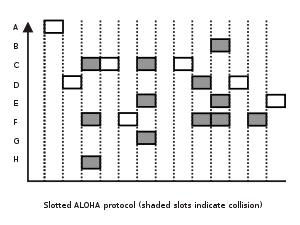
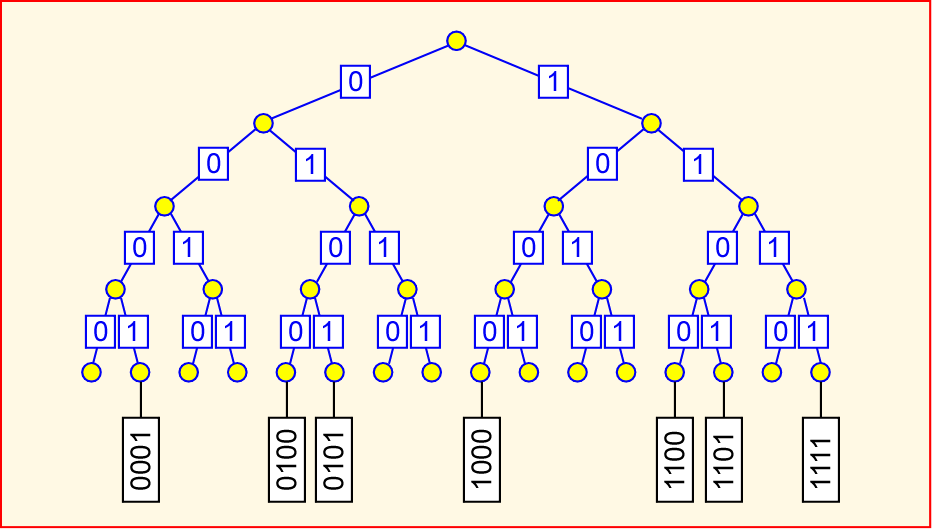
Instances where two readers have an overlapping detection field are common. To prevent the readers from scanning the same tag simultaneously, the RFID readers will alternate between random frequencies within their bandwidths in a process known as frequency hopping.
Reader Implementation
RFID readers are manufactured in three formats. Choice of format depends on application.
- Handheld readers are battery-powered, mobile devices which allow system users to read and alter RFID tags once they are scanned. These readers usually include a keyboard to allow immediate updates to the tag. Handheld readers are wirelessly connected to database software.
-
Fixed readers are stationary and the RFID tag must be placed within the detection range of the reader. In some instances the fixed reader is incorporated into an archway so pallets of inventory can be automatically logged as it passes through.
-
Vehicle-mounted readers are placed on forklifts, pallet trucks, or on other freight handling equipment to automatically read and record the locations of cargo as it is relocated or loaded for transportation.
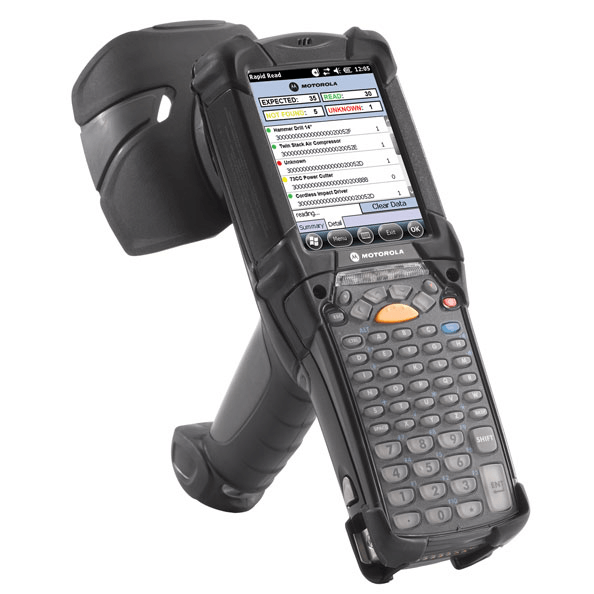
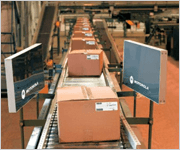
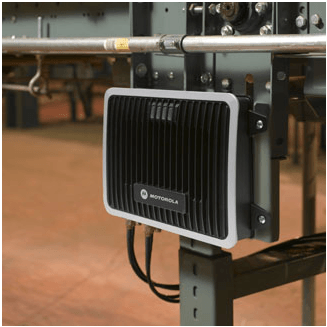
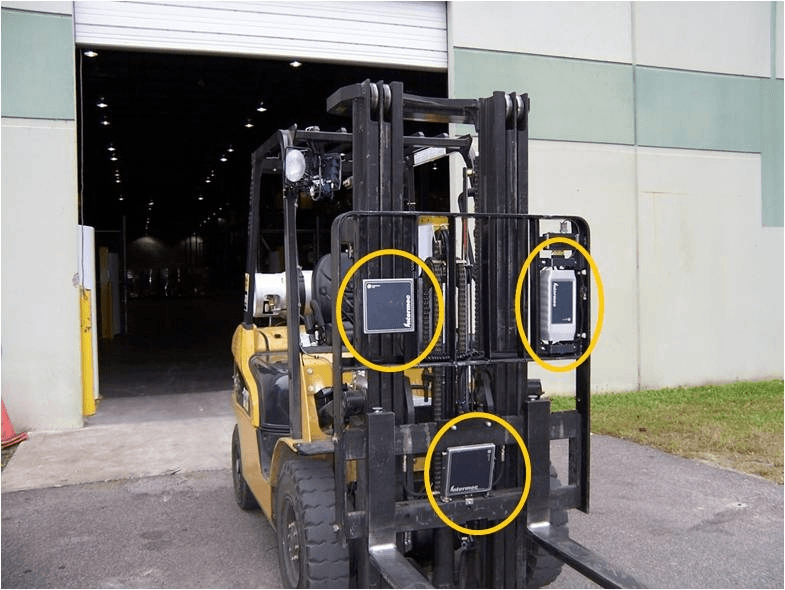
Handheld reader; fixed reader; fixed reader; vehicle-mounted readers
Images credits: Motorola Solutions; Blue Star Inc.; Motorola Solutions
NFC
NFC, or near field communication, is a short range subset of radio-frequency identification (RFID) communication protocols that use electromagnetic radio fields for connecting electronic devices. NFC-enabled devices may be passive or active with passive devices allowing only reading from other devices while active can read and send information. NFC operates at 13.56 MHz at a distance of 4 cm and has a data transfer rate up to 424 kbps. It is used in the consumer electronics industry allowing users to connect to other NFC-enabled devices without compromising personal data.
Standards
The intrinsic relationship between RFID tags and readers means most standards apply to the operation of both devices. The standards listed below are important to many applications.
- ISO/IEC 18000-1 RFID use for item management across many frequencies
- ISO/IEC 21481RFID information exchange and protocols
- ISO/IEC 18046-1 RFID devices, performance and test methods
Applications
RFID reader applications are the same as those for RFID tags, since one is useless without the other. Some common applications include those listed below.
- Encrypted readers are employed in scenarios where the RFID is directly linked to a credit or banking account. These readers will sometimes feature a keypad, so the user can enter a PIN and supplementary info.
- In asset tracking, fixed readers are placed at access points so tags can be automatically scanned as it passes. This includes factories and warehouses, as well as retail stores which utilize electronic article surveillance.
- Both handheld and fixed readers are used to scan ID badges and electronic keys; they identify the user and determine access authorization.
- Fixed RFID readers are placed around oil rigs so personnel can be identified and found quickly.
- Veterinarians and animal control workers use RFID readers to identify and update information stored on an RFID implanted under the animal's skin. They are also used to keep track of livestock.
-
Toll roads use RFID readers to allow drivers to use a prepaid toll account. A reader in the vehicle registers transactions the the toll road's RFID reader.
Resources
Wikipedia--Radio-frequency identification
Images credits:
Advanced Infrastructure | Wikimedia | Great Note | Motorola Solutions | Blue Star Inc.