Introduced by Texas Instruments over thirty years ago, the digital signal processor (DSP) has evolved in its implementation from a standalone processor to a multicore processing element and has continued to extend in its range of applications. The breadth of software development tools for the DSP has also expanded to accommodate diverse sets of programmers. From small, low power, yet "smart" devices with applications such as voice and image recognition, to multicore, high-performance compute platforms performing real-time data analytics, the opportunities to achieve the low-power processing efficiencies of DSPs are nearly endless. The TI DSP has benefited from a relatively unique tool suite evolution making it easy and effective for the general programmer and the signal processing expert alike to quickly develop their application code. This paper addresses how TI DSP users are able to achieve the high performance afforded by the TI DSP architecture, in an efficient, easy-to-use development environment.
 TABLE OF CONTENTS
 Embedded systems programming using digital signal processors
From DSP-FPGA.com
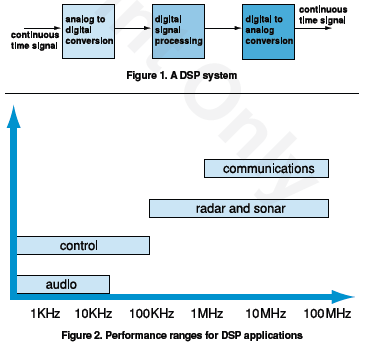
Digital Signal Processing (DSP) is the method of processing signals and data in order to enhance or modify those signals or to analyze those signals to determine specific information content. A typical DSP system (Figure 1) consists of a processor and other hardware used to convert outside analog signals to digital form and possibly back to analog (continuous) form. There is nothing mystical about DSPs. Think of a DSP as an application-specific microprocessor. The applications that these devices are good for are digital signal algorithms, which usually are not on general-purpose processors because of their complexity. The software development issues associated with these devices, however, are similar to other general-purpose processors.
DSPs are becoming common in all product areas, including military and aerospace systems, embedded applications, and PC-based systems.
Is your application right for a DSP?
Engineers developed digital signal processors to solve a particular class of problem. DSP is a way to represent signals as ordered sequences of numbers and techniques to process those sequences. Some of the important reasons to do signal processing include elimination or reduction of unwanted interference, estimation of signal characteristics, and transformation of signals to produce more important information. Some of the common applications of DSP include:
Each DSP application is different. One of the first tasks of the system designer is to determine how much processor is required to perform the job. Figure 2 shows typical performance ranges for some DSP applications. Simple controlbased applications do not need high-performance DSPs, whereas higher performance ranges are required for applications such as radar and sonar.
Products & Services
Product Announcements
|
|
||||||
|
|
||||||
|
|



Topics of Interest
Introduced by Texas Instruments over thirty years ago, the digital signal processor (DSP) has evolved in its implementation from a standalone processor to a multicore processing element and has...
Chapter List Chapter 4.1: Analog/Digital Signal Conversion Chapter 4.2: Digital Filters Chapter 4.3: Digital Modulation Chapter 4.4: Digital Video Sampling Chapter 4.5: DSP Devices and Systems...
Chapter List Chapter 6.1: Analog/Digital Signal Conversion Chapter 6.2: Digital Filters Chapter 6.3: Digital Modulation Chapter 6.4: DSP Devices and Systems Part Overview Digital signal...
Texas Instruments' (TI) Integra™ DSP+ARM devices combine a digital signal processor (DSP) and an ARM® processor, enabling developers to create applications best suited for executing a...
Digital Signal Processing (DSP) has been evolving over the past thirty years, spurred by the rapid advances in computer technology. It has grown into a discipline that makes an impact on almost...