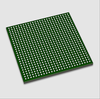
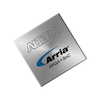
FPGAs are increasingly used as parallel processing engines for demanding digital
signal processing applications. Benchmark results show that on highly parallelizable
workloads, FPGAs can achieve higher performance and superior cost/performance
compared to digital signal processors (DSPs) and general-purpose CPUs. However, to
date, FPGAs have been used almost exclusively for fixed-point DSP designs. FPGAs
have not been viewed as an effective platform for applications requiring high-performance
floating-point computations. FPGA floating-point efficiency and performance has been
limited due to long processing latencies and routing congestion. In addition, the traditional
FPGA design flow, based on writing register-transfer-level hardware descriptions in
Verilog or VHDL, is not well suited to implementing complex floating-point algorithms.
Altera has developed a new floating-point design flow intended to streamline the
 TABLE OF CONTENTS
 Graphically better designs with FPGAs
From DSP-FPGA.com
FPGAs clearly provide performance and economic benefits for many applications. Traditional FPGA design tools present technical barriers for many domain experts. By employing a graphical system design approach to FPGA designs, domain experts can easily implement their ideas to achieve high-speed control, ultimate reliability, and field-reprogrammable systems so they can design their applications without the cost of hiring embedded experts. As FPGAs continue to expand into more applications, graphical system design will remain the most accessible technique to benefiting from FPGA technology.
Moore’s Law drove microprocessors to ubiquity in applications from Apple iPods to ultra-high performance PCs. Now it’s time for field-programmable gate arrays (FPGAs) to take the role of ubiquitous processing and logic.
FPGA functionality and popularity has grown at an annual growth rate well above that of general electronics. Their attractiveness arises from two fundamental factors. Technically, they provide higher density and performance than discrete logic. Economically, FPGAs are a low-cost alternative to ASICs and ASSPs where development time costs are too expensive to justify for the volume.
By integrating multiple arithmetic units, DSP blocks, and microprocessors, FPGAs offer significantly more performance than DSPs or microprocessors alone. FPGAs are clearly moving past their role as “glue logic” by integrating multiple types of I/O including highspeed serial, Ethernet, and PCI Express. Designers benefit from FPGA logic directly in hardware with true parallel execution, and FPGA fabric for integrating various heterogeneous processing elements.
Products & Services
Product Announcements
|
|
||||||
|
|


Topics of Interest
FPGAs are increasingly used as parallel processing engines for demanding digital signal processing applications. Benchmark results show that on highly parallelizable workloads, FPGAs can achieve...
The use of FPGAs in many applications is rapidly increasing. With the attributes of reconfigurability and design-to-working part times much faster than those of ASICs, FPGAs offer avionics engineers...
The use of FPGAs in many applications is rapidly increasing. With the attributes of reconfigurability and design-to-working part times much faster than those of ASICs, FPGAs offer avionics engineers...
Jeff K, as he’s known in the LabVIEW community, has a unique vision for how people should program and who should program. He shares some exclusive thoughts with us on where he sees NI’s technology...
CHAPTER LIST Chapter 45: Field-Programmable Gate Array Architectures Chapter 46: FPGA Technology Mapping, Placement, and Routing Chapter 47: Physical Design for Three-Dimensional Circuits Steven...