 | The dramatic reduction in transmission loss of optical fibers coupled with very important developments in the area of light sources and detectors have resulted in phenomenal growth of the fiber optic industry during the last 35 years or so. Indeed, the birth of optical fiber communication systems coincided with the fabrication of low-loss optical fibers and the operation of room-temperature semiconductor lasers in 1970. Since then, scientific and technological growth in this field has been phenomenal. Although the major applications of optical fibers have been in the area of telecommunications, many new areas, such as fiber optic sensors, fiber optic devices and components, and integrated optics, have witnessed immense growth. |
As with any technological development, the field of fiber optics has progressed
through a number of ideas based on sound mathematical and physical principles.
For a thorough understanding of these, one needs to go through a good amount of
mathematical rigor and analysis, which is carried out in undergraduate and graduate
curricula. At the same time there are a sizable number of engineering and technical
professionals, technical managers, and inquisitive students of other disciplines
who are interested in having a basic understanding of various aspects of fiber optics
either to satisfy their curiosity or to help them in their professions. For these
professionals a book describing the most important aspects of fiber optics without
too much mathematics, based purely on physical reasoning and explanations, should
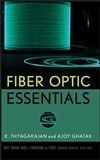
be very welcome. A book taking the reader from the basics to the current state of
development in fiber optics does not seem to exist, and the present book aims to fill
that gap.
The book begins with a basic discussion of light waves and the phenomena of
refraction and reflection. The next set of chapters introduces the reader to the field
of fiber optics, discussing different types of fibers used in communication systems,
including dispersion-compensating fibers. In later chapters we discuss recent developments,
such as fiber Bragg gratings, fiber amplifiers, fiber lasers, nonlinear fiber
optics, and fiber optic sensors. Examples and comparison with everyday experience
are provided wherever feasible to help readers understanding by relation to known
facts. The book is interspersed with numerous diagrams for ease of visualization of
some of the concepts.
The mathematical details are kept to a bare minimum in the hope of providing easy
reading and understanding of some of the most important technological developments
of the twentieth century, which are penetrating more and more deeply into our society
and helping to make our lives a bit easier.
We are very grateful to all our colleagues and students at IIT Delhi for numerous
stimulating discussions and academic collaborations. One of the authors (A.G.) is
grateful to Disha Academy of Research and Education, Raipur for supporting this
endeavor.
K. THYAGARAJAN
AJOY GHATAK
New Delhi
 TABLE OF CONTENTS