Fiber Optic Essentials

Chapter 12.7.1 - Fiber Optic Components: External Modulators

We mentioned earlier that laser diodes can be modulated directly by varying the
current through them. Thus, a bit stream in the electrical domain can be converted
directly into a bit stream in the optical domain by direct modulation. When this is
carried out, it is found that the wavelength of the laser gets chirped within the pulse,
due to the variation of electron concentration within the laser. Since the spectral
bandwidth of a chirped laser is larger than that of an unchirped laser, and dispersion
through a fiber depends on the bandwidth, the dispersion suffered by a pulse formed
by a chirped laser is greater than that due to an unchirped laser. This increase is
not very significant at bit rates of 2.5 Gb/s, but for higher bit rates, such as 10 and
40 Gb/s, it can affect the repeater spacing considerably. In view of this, for higher
bit rates an external modulation scheme is used rather than direct modulation. In this
scheme the laser operates continuously and passes through an external modulator
that converts the continuous wave into pulses according to the data. Many different
methods are used to achieve this external modulation. Here we describe the most
common technique using an electrooptic modulator.

There are crystals such as lithium niobate whose refractive index can be changed
by an applied electric field. For an applied electric field E, the change in refractive
index Δn of the crystal is given by


where r, the effective electrooptic coefficient, depends on the material and on the
polarization states of the light and the direction of applied electric field within the
crystal, and n represents the refractive index of the material in the absence of an
external electric field.

As an example we consider lithium niobate, for which if the electric field is applied
along a specific direction (referred to as the optic axis) and if the incident light is
polarized along the direction of the optic axis, r = 30 × 10-12 m/V and n 2.2.
Hence, if a potential difference of 100 V is applied across a crystal of thickness
1 mm, the electric field generated is 105 V/m. For this applied voltage the change in
refractive index is approximately 1.6 × 10⁻⁵, which is indeed a small shift. If the
light beam propagates through such a crystal, this change in refractive index would
lead to a change in the phase of the light beam passing through the crystal. If the
wavelength of light is 1.5 μm and the crystal length is 2 cm, the change in phase
due to application of this electric field would be about 0.4π, which is not a small
change if we remember that in interference the intensity of the interference pattern
can change from maximum to minimum for a change of phase of π.

An electrooptic modulator utilizes this change in refractive index due to an applied
electric field to modulate a light beam. Hence, when the refractive index is modulated
using the electric field, the phase of the output light beam also gets modulated, and
if the output is made to interfere with a second beam, which has not undergone
modulation, the interference between the two waves will lead to modulation of the
resulting intensity. When the waves are in phase (the crest of one wave overlapping
with the crest of the other wave) they will add constructively, and when they are out of
phase (the crest of one wave overlapping with the trough of the other wave), they will
add destructively. Thus, if the electric field is switched on and off in accordance with
the signal bits, the output light wave from the device will replicate the bit sequence.
This is the basic principle of an electrooptic amplitude modulator.

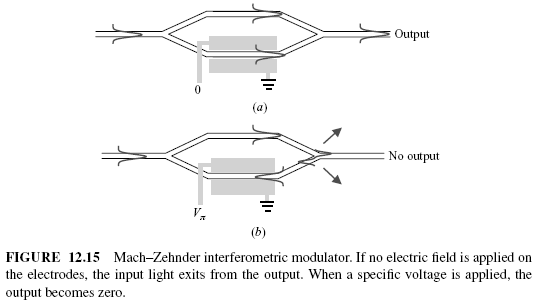
The modulation described above is generally achieved using a Mach–Zehnder
interferometer, shown in Fig. 12.15 (see also Chapter 14). An input waveguide
splits into two waveguides which recombine after a certain length. An electric field
is applied to one of the waveguides using a pair of electrodes. When no voltage
is applied, the output from both arms come in phase and results in output from
the device. When an appropriate voltage is applied to the electrode to make the

FIGURE 12.15 Mach–Zehnder interferometric modulator. If no electric field is applied on the electrodes, the input light exits from the output. When a specific voltage is applied, the output becomes zero.

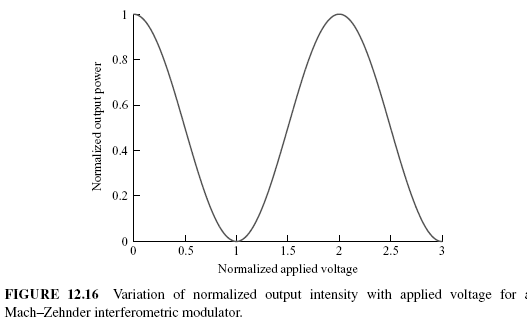
two waves interfere destructively, there is no output from the device. Figure 12.16
shows a typical variation of output intensity with applied voltage showing sinusoidal
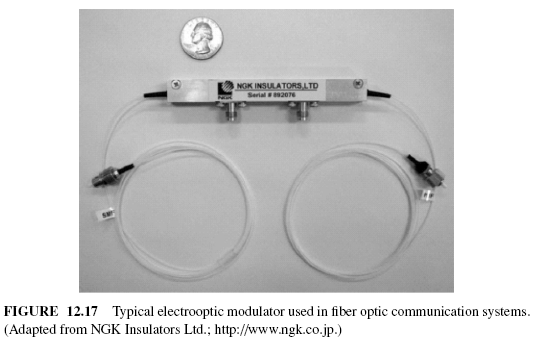
dependence. Figure 12.17 shows a typical intensity modulator connected using fiber
optic pigtails. Such modulators can be used to modulate at very high speeds of 10
and 40 Gb/s. They typically require voltages of less than 5 V for operation and are
used in high-speed fiber optic systems.

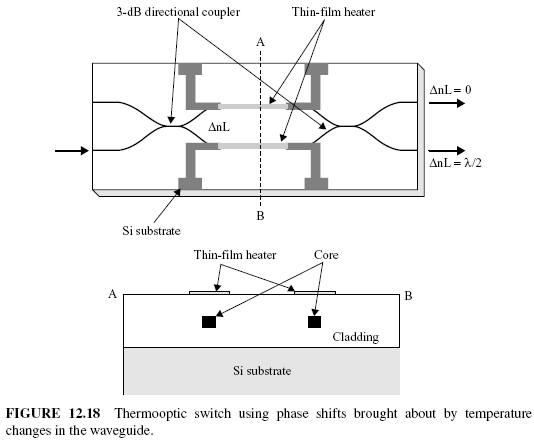
Figure 12.18 shows a thermooptic modulator based on a Mach–Zehnder interferometer
based on silicon technology. The waveguides used to guide light are made
of silica and are built on a silicon substrate. By placing heaters on the waveguides,

FIGURE 12.16 Variation of normalized output intensity with applied voltage for a Mach–Zehnder interferometric modulator.


FIGURE 12.17 Typical electrooptic modulator used in fiber optic communication systems.


FIGURE 12.18 Thermooptic switch using phase shifts brought about by temperature changes in the waveguide.

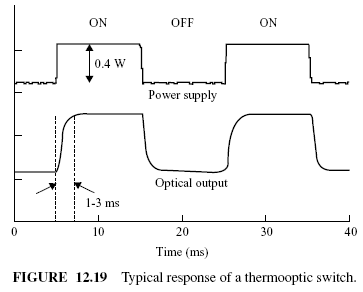
 FIGURE 12.19 Typical response of a thermooptic switch.

the phase of light propagating in the waveguides can be changed by temperature
change brought about by the heating elements. This change then causes a change in
the output intensity. Of course, unlike electrooptic modulators, such devices are slow
since thermal effects are much slower then electrooptic effects. Figure 12.19 shows
a temporal response of the device, showing a switching time of a few milliseconds;
the corresponding power requirement is less than half a watt.

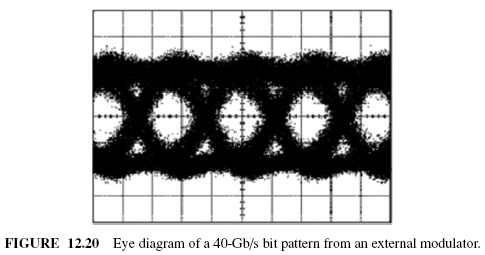
Figure 12.20 shows the eye pattern of the output from a modulator operating at
40 Gb/s. The drive voltage required for the device is only 4.1 V, and the insertion
loss of the device is 5.4 dB. Thus, such electrooptic modulators can help in very
high speed modulation of laser diodes and are being used in high-speed optical fiber
communication systems.

FIGURE 12.20 Eye diagram of a 40-Gb/s bit pattern from an external modulator.


FIGURE 12.21 Optical switch based on a directional coupler. Such switches are fabricated in substrates such as lithium niobate or in semiconductors.


UNLIMITED FREE
ACCESS
TO THE WORLD'S BEST IDEAS

SUBMIT
Already a GlobalSpec user? Log in.

This is embarrasing...

An error occurred while processing the form. Please try again in a few minutes.

Customize Your GlobalSpec Experience

Category: Optical Linear Encoders
Finish!
Privacy Policy

This is embarrasing...

An error occurred while processing the form. Please try again in a few minutes.