Fiber Optic Essentials

Chapter 12.4.1 - Fiber Optic Components: Fiber Optic Couplers

12.4   FIBER OPTIC COUPLERS

In fiber optic communication systems, it is often necessary to tap a small amount of
power from the signal. It may also be necessary to split the signal into two (or more)
parts so that the same signal can reach two (or more) destinations. All this can be
achieved by means of a coupler, which is essentially a fiber optic beamsplitter and is
one of the most important inline fiber components. The schematic of a typical fiber
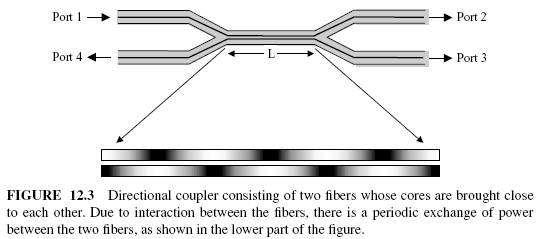
optic directional coupler is shown in Fig. 12.3. The device works on the basic fact that
even though light is confined to propagate along the core of the fiber, a small fraction
of the light extends beyond the core–cladding interface, which of course propagates
along with the light within the core at the same speed. Thus, when two fiber cores
are brought sufficiently close (separation of the order of a micrometer or so) to each
other laterally, periodic exchange of power takes place from one fiber to the other

FIGURE 12.3 Directional coupler consisting of two fibers whose cores are brought close to each other. Due to interaction between the fibers, there is a periodic exchange of power between the two fibers, as shown in the lower part of the figure.

(Fig. 12.3). The fractional power emanating from the two output ports depends on
the length L of the interaction region.

Let P1 represent the power input into port 1 of the coupler, and let the power
coming out of ports 2 and 3 (the output ports) be P2 and P3. The power P4 coming
out of port 4 is usually very small, and if the losses in the coupler (due to absorption,
scattering, etc.) are small, the sum of the powers P2 and P3 is very nearly equal to P1.
The splitting of power between the second and third ports depends on the refractive
index variation of the fibers, proximity of the two cores, the length L of the coupler,
and the operating wavelength. If the two fibers are identical, the power exchange
between the two fibers is complete, whereas if the two fibers are not identical, there is
only incomplete power exchange (Fig. 12.4). In the case of couplersmade of identical
fibers, if power P1(0) is coupled into port 1, the power PT(L) = P2 exiting from port
2 and power PC(L) = P3 exiting from port 3 after an interaction over a length L are
given by


where κ, the coupling coefficient, is a function of the fiber parameters, thewavelength
of operation, and the proximity of the fiber cores. Stronger coupling implies a larger
value of κ, while weaker coupling implies smaller values of κ.

By an appropriate choice of κL, it is possible to achieve any fractional coupling
between the fibers. Thus, it is possible to have an arbitrary fraction of power exiting
from the coupled port (port 3). Thus, by choosing an appropriate length of the coupler,
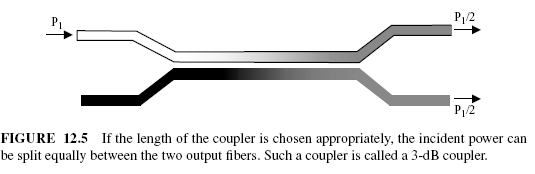
it is possible to achieve equal power outputs from the two ports (Fig. 12.5). Such a
coupler is referred to as a 3-dB coupler since 3 dB corresponds to half (i.e., a coupling

FIGURE 12.4 If the two fibers are nonidentical, the exchange of power is incomplete.


FIGURE 12.5 If the length of the coupler is chosen appropriately, the incident power can be split equally between the two output fibers. Such a coupler is called a 3-dB coupler.


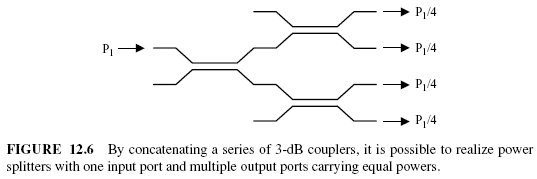
FIGURE 12.6 By concatenating a series of 3-dB couplers, it is possible to realize power splitters with one input port and multiple output ports carrying equal powers.

of 50%). Many 3-dB couplers can be connected one after the other to split the power
further into multiple ports (Fig. 12.6).

Fiber optic couplers are usually specified by some important characteristics. These
include:

    • The coupling ratio: the ratio of the power in the coupled port to the total output.


      Thus, for an input power of 1 mW, if the total output power is 0.9 mW and the
      coupled port carries a power of 0.1 mW, the coupling ratio is about 9.5 dB.
    • The excess loss: the difference in power between the total output power and the
      input power, usually expressed in decibels:


      Thus, if the excess loss is 1 dB, this implies that for an input power of 1 mW,
      the total output power (sum of powers from both the output ports) is about 0.79
      mW; the remaining 0.21 mW is lost due to scattering, absorption, and the like.
    • The insertion loss: the ratio of input power to coupled power:


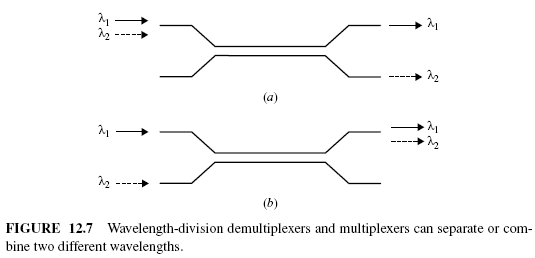
      FIGURE 12.7 Wavelength-division demultiplexers and multiplexers can separate or combine two different wavelengths.
    • The directivity: the power returning in the second input port, measured in decibels:


      If for an input power of 1 mW a power of 0.01 μW emerges from the second
      input port, the ratio of the two powers is 0.00001 and the directivity is −50 dB.

    Tap couplers are couplers in which the fractional power appearing in the coupled
    port is a very small fraction of the light intput into the coupler. Thus, tap couplers
    tapping 1% or 5% of the light beam are used in many applications, such as in EDFAs.

    Since the extent of field penetrating the cladding depends on wavelength, the coupling
    process is wavelength dependent (i.e., the coupling coefficient κ is wavelength
    dependent). Thus, it is possible to design couplers such that when power at two
    wavelengths is incident in the same port of a coupler, one of the wavelengths exits
    from one port while the other wavelength exits from the other port (Fig. 12.7). Such
    a coupler is used to multiplex (combine) or demultiplex (separate) two wavelengths.
    These are referred to as wavelength-division-multiplexing (WDM) couplers and find
    applications in EDFAs to combine the pump and signal power or to separate two
    wavelengths which are separated sufficiently, such as 1310 and 1550 nm.

    Directional couplers have many interesting applications: for example, in power
    splitting, wavelength-division multiplexing and demultiplexing, polarization splitting,
    and fiber optic sensing.

UNLIMITED FREE
ACCESS
TO THE WORLD'S BEST IDEAS

SUBMIT
Already a GlobalSpec user? Log in.

This is embarrasing...

An error occurred while processing the form. Please try again in a few minutes.

Customize Your GlobalSpec Experience

Category: Optical Linear Encoders
Finish!
Privacy Policy

This is embarrasing...

An error occurred while processing the form. Please try again in a few minutes.