3.16 ATM
ATM is a data protocol and technology that was designed to provide quality of service
(QoS), service type flexibility, maintenance, and reliability. ATM concepts
have been the source to other new data protocols and, therefore, we provide a more
in-depth overview.
Quality of Service (QoS) of a connection relates to cell loss, cell delay, and cell
delay variation for that connection in the ATM network. QoS is closely related to
the bandwidth used compared with the bandwidth available.
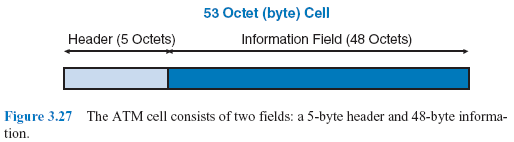
The ATM frame (called a cell) is short and has a fixed length consisting of 53
octets (Figure 3.27). It consists of a 5-octet header and a 48-octet data field. The definition
of the ATM cell header at the user-to-network interface (UNI) differs from
that at the network-to-network interface (NNI) (Figure 3.28).
The GFC field consists of 4 bits and is defined only at the UNI to assist the customer
network in the control of cell flow but not for traffic flow control. GFG is not
carried through the network
The VPI/VCI field consists of 24 bits. They are labels that identify a particular
virtual path (VP) and virtual channel (VC) on a link. The switching node uses this
information and, with the routing information (tables) that have been established at
connection setup, it routes the cells to the appropriate output port. The switching
node changes the input value of the VPI/VCI fields to new output values.
The PTI field consists of 3 bits. It identifies the payload type; that is, whether the
cell payload contains user data or network information. It also indicates the congestion
state. The meaning of each code is:
000: User data cell; congestion not experienced, SDU=0
001: User data cell; congestion not experienced, SDU=1
010: User data cell; congestion experienced, SDU=0
011: User data cell; congestion experienced, SDU=1
100: OAM F5 segment-associated cell
101: OAM F5 end-to-end associated cell
110: Resource management cell
111: Reserved for future

where SDU is a Service Data Unit.
The CLP field consists of 1 bit: 0 = high priority and 1 = low priority. It is set by
the user or service provider. In congestion, the CLP status determines whether cells
will be dropped or passed.
The HEC field is used for error detection/correction. This code detects and corrects
a single error in the header field or it detects multiple errors. It is based on the
x8 + x2 + x + 1 CRC code.
The HEC is also used for cell delineation. The remainder of the polynomial is
EX-ORed with the fixed pattern “01010101,” and this is placed in the HEC field. At
the receiving end, the generating polynomial results in a HEC pattern “01010101,”
which is used to locate the start of the cell.
When ATM transmits cells, some carry client data and some are defined for other
uses. A list of such cells follows:
| Idle Cell: | Is inserted/extracted by the physical layer in order to adapt |
| | the cell rate to the available rate of the transmission system |
| Valid Cell: | Is a cell with no header errors, or with a corrected error |
| Invalid Cell: | Is a cell with a noncorrectable header error |
| Assigned Cell: | Is a valid cell that provides a service to an application us- |
| | ing the ATM-layer service |
| Unassigned Cell: | Is not an assigned cell |
| Meta-signaling Cell: | Is used for establishing/releasing a VCC. VCs in Perma- |
| | nent Virtual Connections need no meta-signaling. |
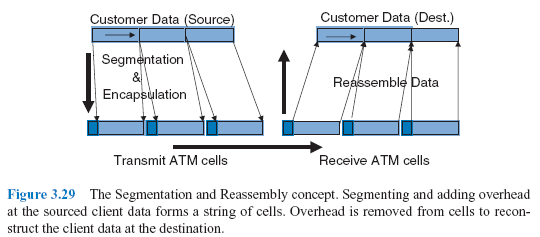
Client data may consist of long packets (much longer than 53 bytes) or a continuous
(synchronous) bit stream. To transport client data over ATM, a function is performed
by which data is segmented into up to 47 or 48 octets, overhead is added,
and a string of ATM cells is formed. This function is known as segmentation and
reassembly (SAR) (Figure 3.29).
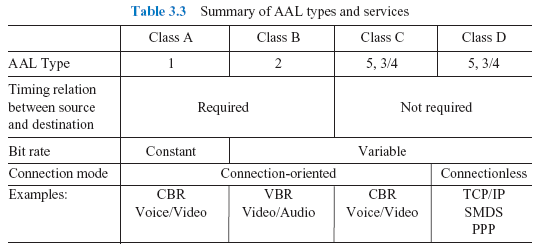
ATM defines different adaptation layers (AALs), each one suited for different
services such as voice, video, TCP/IP, and so on. Table 3.3 summarizes the AAL
types and services.
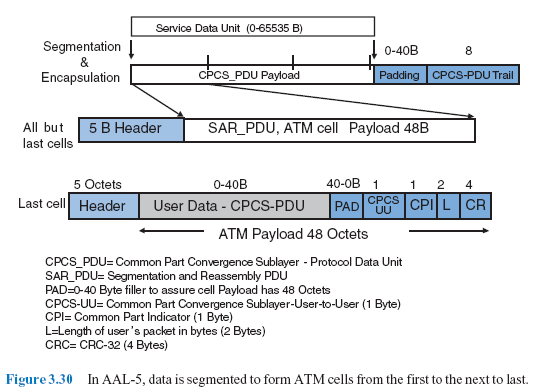
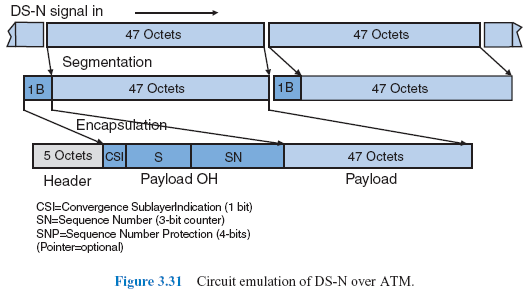
The complete treatment of ATM SAR is beyond our purposes. However, because
of its relevance to client data, two examples are discussed here: the AAL-5,
illustrated in Figure 3.30, and the circuit emulation that translates traditional rates
such as DS1, E1, and DS3, into ATM cell traffic (Figure 3.31).
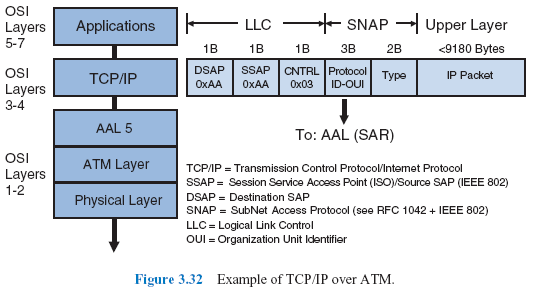
AAL-5 is straightforward and more efficient for point-to-point ATM links. All
AAL-5 cells are sent sequentially and, thus, there is no missequencing protection,
and error control is included in the last ATM cell (SAR_PDU). As an example, Figure
3.32 illustrates the transport of TCP/IP over ATM. In a similar manner, IETF
RFC 1483 defines the SAR of Ethernet over ATM.
Semantic transparency determines the capability of a network to transport information
from source to destination with an acceptable number of errors and performance
metrics.
Errors are defined on the bit level as well as on the packet level:
- The bit error rate (BER) is defined as the ratio of erroneous of bits found over
the total number of bits transmitted in a time interval. - The packet error rate (PER) is defined as the ratio of erroneous packets or cells
found over the total number of packets or cells transmitted in a time interval.
In addition, there are errors that pertain to the accuracy of system such as the
misinsertion packet or cell rate (CMR), which is defined as the ratio of cells or
packets misinserted over a time interval.
Errors pertaining to the accuracy of the path include the packet or cell loss rate
(CLR), which is defined as the number of lost cells over the total number of packets
or cells sent.
There are performance metrics pertaining to the system speed such as the packet
or cell transfer delay (CTD), which is defined as elapsed time between an exit and
an entry measuring point for a cell.
There are also performance metrics pertaining to the path speed such as the
packet or cell delay variation (CDV), which is defined as the variability of cell arrival
for a given connection.
ATM is a data standard with extensive traffic parameter requirements and quality
of service features. New versions of other data standards make an attempt to
adopt these parameters and features as close as possible. In the service level agreement
of ATM, some of the defined parameters are:
- The peak cell rate (PCR), defined as the permitted burst profile of traffic associated
with each UNI connection. This is the maximum cell rate in a time interval. - The sustainable cell rate (SCR) is defined as the permitted upper bound on the
average rate for each UNI connection. - Traffic shaping (TS) is defined as the function that alters the flow (or rate) of
cells in a connection, to comply with the agreed QoS requirements (rate reduction,
cell discarding). - Maximum burst size (MBS) defines the length of bursty cells in a period.
Similarly, ATM defines a large variety of services that new versions of other data
standards make an attempt to adopt. In the service level agreement of ATM, the defined
services are:
- Constant Bit Rate (CBR) when ATM bits or cells arrive at a negotiated constant
cell rate. It requires low cell-loss rate (<10E-9) and stringent cell-delay
variation. - Variable Bit Rate (VBR) when ATM bits or cells arrive at a negotiated variable
cell rate characterized by a minimum and maximum rate and burstiness.
This category is subdivided into:
—Real-Time Variable Bit Rate (rt-VBR) when ATM bits or cells arrive at a
negotiated variable rate characterized by a minimum and maximum rate
and burstiness. It requires low cell-loss rate (<10E-9) and stringent cell-delay
variation.
—Non-Real-Time Variable Bit Rate (nrt-VBR) when ATM bits or cells arrive
at a negotiated variable rate characterized by a minimum and maximum
rate and burstiness. It requires low cell-loss rate but has no requirements
for cell-delay variation. - Available Bit Rate (ABR) when ATM cells arrive at a cell rate, determined by
the network, based on congestion states and network resources along the path. - No explicit CLR but (<10E-5) is expected. The network guarantees to ABR
connections a minimum cell rate (MCR). - Undefined Bit Rate (UBR) when there are no specific QoS requirements. This
service is intended for non-real-time applications, such as file transfer protocol
(FTP), electronic mail, and low-cost transmission control protocol/Internet
protocol (TCP/IP) with non-real-time requirements.
In addition, the Burst Tolerance (BT) parameter defines the tolerance on additional
traffic above the SCR. When this tolerance is exceeded, the ATM traffic is tagged
as excessive traffic and it may be lost. BT is defined by

The above traffic parameters and defined ATM services are provided by the user
during connection admission control (CAC) at UNI.
An end-to-end connection is established with a series of virtual channel (VC)
links from source to destination. This is known as Virtual Channel Connection
(VCC). The VCI in the ATM header cell identifies the VC.
Each switching node, upon receiving a cell and based on routing translation tables,
translates the incoming VCI into an outgoing VCI. Thus, the VCI value is different
from node to node. The translation values at each node are determined during
the setup of the connection.
An end-to-end connection of a bundle of virtual channel (VC) links is established
from source to destination. This is known as Virtual Path Connection (VPC).
The VPI in the ATM header cell identifies the VPC. Each ATM cell in the bundle
has the same VPI.
VPCs may be permanent or on-demand. Permanent connection is established by
provisioning the network (by subscription) and, thus, signaling procedures are not
used. On-demand connections require signaling procedures so that VPCs may be
set up and released by the network or by the customer.
Each switching node, upon receipt of a bundle and based on routing translation
tables, translates the incoming VPI into an outgoing VPI. Thus, the VPI value is dif-
ferent from node to node. The translation values at each node are determined during
the setup of the connection.
© 2004

 PREFACE
 TABLE OF CONTENTS