Advanced Temperature Measurement and Control

Unit 5.1 - Process and Equipment Design Considerations

UNIT 5

Exchangers

This unit describes control strategies and operational considerations for shell and tube heat exchangers.

Learning Objectives When you have completed this unit you should:

  1. Understand how some exchanger designs make temperature control nearly impossible.

  2. Know how to compensate or adapt for changes in the process gain, dead time, and constant.

  3. Recognize the limitations of some control schemes.

  4. Be able to construct the best control strategy.

5-1. Process and Equipment Design Considerations

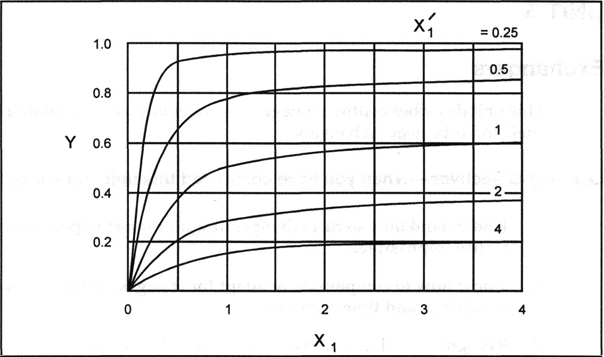
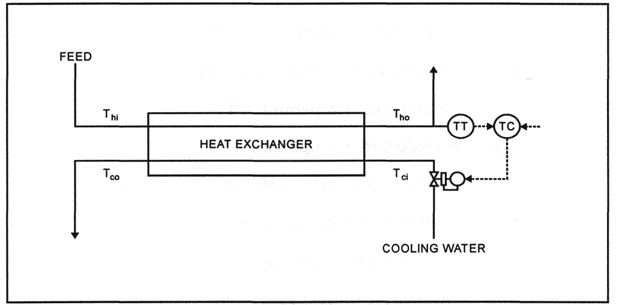
If either of the ratios X1 and X2, as defined by Eqs. (5-1a), (5-1b), (5-2a) and(5-2b) and illustrated by associated Figs. 5-1 and 5-2, are greater than three, the change in the controlled temperature with manipulated flow is often too small for good control (for the counterflow liquid - liquid heat exchanger depicted in Fig. 5-3) (Ref. 1). This loss of process sensitivity will show up as prolonged deviations of the measurement from set point for increases in heat load. Very high controller gains and feedforward control can help, but the loop often runs out of valve (i.e., the control valve is wide open and controller output is at its output limit). Differences in exchanger design and process conditions may shift this point but the problem remains the same. The system should be designed to eliminate high flow operation to avoid insufficient process sensitivity and high energy usage from larger coolant pressure drops and flow.

The abscissa Y, per Eqs. (5-3a) and (5-3b), is the temperature drop, or rise from inlet to outlet on the controlled side, normalized by division by the maximum possible temperature change, which is the difference between the hot and cold inlet temperatures (Ref. 1). The slope of Figs. 5-1 and 5-2 is representative of the process gain. Thus, the process gain increases as the manipulated flow decreases. The slope gets exceptionally steep as the coolant flow approaches zero. The exchanger and control system should be designed to eliminate low flow operation to avoid excessive process sensitivity and the dramatic increase in fouling of the heat transfer surfaces that occurs at low velocities.

05_Advanced_Temperature_Measurement_and_Control-1.gif

Fig. 5-1. If the heat transfer area is too small or large, the process gain will be too large or small, respectively (Ret. 1).

Thus, the mechanical and process design that sets the heat transfer areas and geometry can make the control easy or difficult. While advanced control methods can treat the symptoms, the better solution is to eliminate the root cause of the problem by early involvement of the process control engineer in the exchanger design. Note that X1' is the X1 for the side not manipulated. Thus, if Eq. (5-1a) is used for X1, then Eq. (5-1b) is used for X1', and vice versa.

05_Advanced_Temperature_Measurement_and_Control-2.gif

Fig. 5-2. If the uncontrolled flow is too small or large, the process gain will be too large or small, respectively (Ref. 2).

05_Advanced_Temperature_Measurement_and_Control-3.gif

Fig. 5-3, In counterflow liquid - liquid exchangers, the temperature difference at each end of the exchanger is maximized by pairing the cold inlet with the hot outlet and the cold outlet with the hot inlet.

For control and manipulation of cold side:

 X,

= (Fc * Cc) / (U * A)

(5-1a)

 X2

= F/Fh

(5-2a)

 Y

= (Tci - Tco)/(Thi - Tci)

(5-3a)

For control and manipulation of hot side:

 X1

= (Fh * Ch) / (U * A)

(5-1b)

 X2

= F/Fh

(5-2b)

 Y

= (Tho-Thi)/(Thi-Tci)

(5-3b)

where:


A

= heat transfer area (ft.2)

Cc

= cold side liquid heat capacity (Btu/°F*lb)

Ch

= hot side liquid heat capacity (Btu/°F*lb)

Fc

= cold side mass flow (lb/hr)

Fh

= hot side mass flow (lb/hr)

Tci

= cold side inlet temperature (°F)

Tco

= cold side outlet temperature (°F)

Thi

= hot side inlet temperature (°F)

Tho

= hot side outlet temperature (°F)

U

= overall heat transfer coefficient (Btu/hr*ft2)

X1


= abscissa for process gain plot 1

X2

= abscissa for process gain plot 2

Y

= ordinate for proceess gain plots


05_Advanced_Temperature_Measurement_and_Control-4.gif

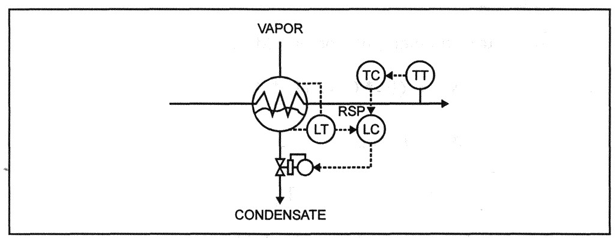
Fig. 5-4. The manipulation of condensate removal rate directly by a temperature controller causes poor control due to excessive dead time in a loop with an integrating response.

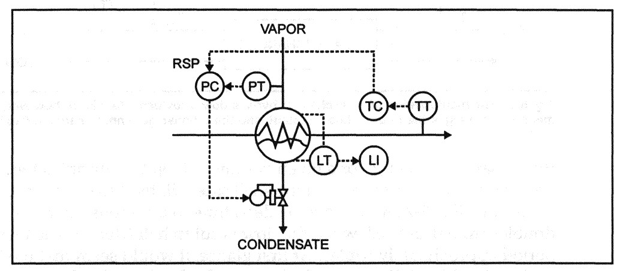
For condensing streams (e.g., steam or column overheads), a smaller control valve can be used by throttling the condensate drain as shown in Fig. 5-4. Since the heat transfer coefficient for condensing vapor is much higher than for a low velocity liquid, an increase in liquid level that covers the heat transfer area will decrease the heat transfer and raise the controlled temperature. However, this puts an integrator (i.e., level) in a control loop that has significant loop dead time of about one minute or more due to heat transfer lags and the measurement lag. For small diameter condensers, the loop could always become unstable if the level change during the loop dead time is a large portion of the level span. Furthermore, the speed of a level decrease may be faster than a level increase because the condensate removal rate can be much larger than the condensation rate. The result is poor control Manipulation of condensate removal rate by a vapor pressure controller provides much better performance because the loop dead time is less than a second. Also, the vapor pressure will pick up changes in the condensing rate as change in pressure and compensate for them before they affect the controlled temperature. The vapor pressure can be the sole, or as shown in Fig. 5-5, the inner (i.e., secondary) loop of a cascade system.

05_Advanced_Temperature_Measurement_and_Control-5.gif

Fig. 5-5. The use of vapor pressure as an inner loop to manipulate condensate removal rate provides control of condensate level and compensates for load upsets that change condensing rates before they affect the controlled temperature.

UNLIMITED FREE
ACCESS
TO THE WORLD'S BEST IDEAS

SUBMIT
Already a GlobalSpec user? Log in.

This is embarrasing...

An error occurred while processing the form. Please try again in a few minutes.

Customize Your GlobalSpec Experience

Category: Resistive Temperature Devices (RTD) Elements
Finish!
Privacy Policy

This is embarrasing...

An error occurred while processing the form. Please try again in a few minutes.