Aircraft System Identification: Theory and Practice
5.1: Ordinary Least Squares

5.1 Ordinary Least Squares

The general form of the model equation (5.3) and the regression equation (5.4) can be written using vector and matrix notation as


and


where

  • z=[ z(1) z(2) z( N)] T= N 1 vector

  • ?=[ ? 0 ? 1 ? n] T= n p 1 vector of unknown parameters, n p= n+1

  • X =[1 ? 1 ? n] =N n p matrix of vectors of ones and regressors

  • v =[ v(1) v(2) v(N)] T= N 1 vector of measurement errors

The regressor vectors ? j, j=1,2,..., n, are known postulated functions of the vectors of independent variables. Usually, at least some of the regressors are equal to the independent variables themselves.

Regression equation (5.6) is equivalent to measurement equation (4.2), with H = X . For the least-squares model, there are no probability statements regarding ? or v , but v is assumed to be zero mean and uncorrelated, with constant variance,


As discussed in Chapter 4, the best estimator of ? in a least-squares sense comes from minimizing the sum of squared differences between the measurements and the model,


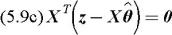
The parameter estimate that minimizes the cost function J( ?) must satisfy


or


or


The n p= n+1 equations represented in Eqs. (5.9) are called the normal equations.

UNLIMITED FREE
ACCESS
TO THE WORLD'S BEST IDEAS

SUBMIT
Already a GlobalSpec user? Log in.

This is embarrasing...

An error occurred while processing the form. Please try again in a few minutes.

Customize Your GlobalSpec Experience

Category: Squares
Finish!
Privacy Policy

This is embarrasing...

An error occurred while processing the form. Please try again in a few minutes.