Aircraft System Identification: Theory and Practice

A random variable X is a quantity that can take on values randomly according to a probability
( X ? x), where x is a selected value. The probability
(X ?x) gives a scalar value on the interval [0,1] indicating the probability that the random variable X will take on a value less than or equal to x. Consequently,
(X ?x) depends on x. A probability of 0 corresponds to an impossibility, whereas a probability of 1 corresponds to certainty.
Random variables can be discrete or continuous. In the development given here, only continuous random variables will be considered, and each random variable is denoted by a capital letter. These conventions are not adhered to in the chapters.
The probability distribution function of a random variable X is defined by
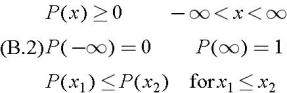
where P(x) is a scalar value on the interval [0, 1] indicating the probability that the random variable X will take a value less than or equal to x. Some properties of the probability distribution function are
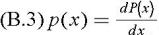
The probability density function of the random variable X, also known as the frequency function, is defined as
Then
and
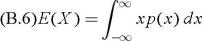
The expected value, or the mean, of a random variable X is defined by
where p(x) is the probability density function for X. If the same experiment is repeated N