Aircraft System Identification: Theory and Practice
Appendix C: Reference Information

C.1 Properties of Air and the Atmosphere

The forces and moments acting on a body due to fluid flowing over the body depend in part on the properties of the fluid. For an airplane flying in the atmosphere, the properties of air are relevant. These properties generally change with weather conditions and also with altitude.

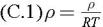
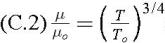
The air properties of interest are the number of air molecules per unit volume, quantified by the air density, the resistance of air molecules to relative motion with respect to neighboring air molecules, quantified by the viscosity, and the speed with which air molecules transmit pressure disturbances, quantified by the speed of sound. These air properties can be modeled as functions of static air pressure and temperature,


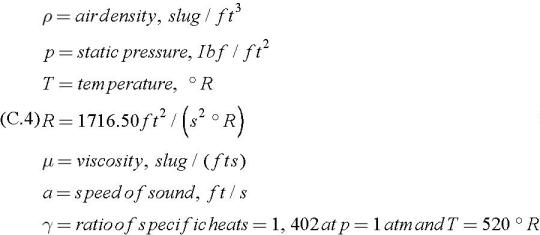
where subscript o denotes a reference condition, and


To standardize results by removing weather differences among different days, a standard set of atmospheric conditions has been defined, called the standard atmosphere. Using the standard atmosphere, comparisons can be properly made using the same atmospheric conditions. Table C.1 shows conditions for the 1976 U.S. standard atmosphere.1 The data in Table C.1 show that the air density, static pressure, and temperature all decrease with increasing altitude. Warmer, denser, higher-pressure air lies at the bottom of the atmosphere.

Table C.1: U.S. standard atmosphere, 1976

Alt., ft

T, R

p, lb/ft 2

?/ ? 0

?, Ib-s 2/ft 4

a, ft/s

0

518.67

2116.2

1.00000

0.0023769

1116.44

1,000

515.10

2040.8

0.97107

0.0023082

1112.60

UNLIMITED FREE
ACCESS
TO THE WORLD'S BEST IDEAS

SUBMIT
Already a GlobalSpec user? Log in.

This is embarrasing...

An error occurred while processing the form. Please try again in a few minutes.

Customize Your GlobalSpec Experience

Category: Industrial Gases
Finish!
Privacy Policy

This is embarrasing...

An error occurred while processing the form. Please try again in a few minutes.