Channels, Propagation and Antennas for Mobile Communications
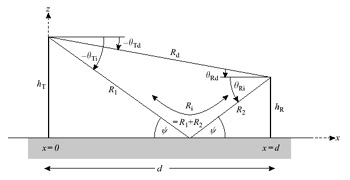
The simplest case of multipath propagation comprises one reflected path in addition to a direct path. This section discusses the fields resulting from a reflection from a smooth planar surface, which has direct relevance to propagation along streets and across rural areas, and provides the basic reflection mechanism used in later sections. The geometry is given in Figure 3.1.1 where the transmitter and receiver are at heights h T and h R respectively, and are separated by a horizontal distance d. The quantity
is the path difference between the indirect path length R i and the direct path length R d, and E 0 is the field at the receiver position resulting from the direct free space path.
The reflection coefficients are given by the Fresnel coefficients R v and R h