Channels, Propagation and Antennas for Mobile Communications

Chapter 4: Propagation Modelling

Overview

A variety of methods have been applied to the problem of path loss in real environments, natural or man made. A number of methods have been parametric in the sense that a few parameters describe the path loss based on experimental results, thus yielding fast results for network planning. Others have been more based on simple modelling, like a few knife edges, and then treated by approximate methods. Recently, there has been some interest in a more accurate, deterministic modelling of the environment, especially for indoor and microcell situations. First, the outdoor above rooftop case will be treated in the urban environment, followed by the rural case and the indoor environment. Additionally, the time domain response as well as the angular response are treated since they are important for wideband systems and for the use of adaptive antennas.

4.1 Propagation in urban environments above rooftops

4.1.1 Okumura Hata case for urban environments

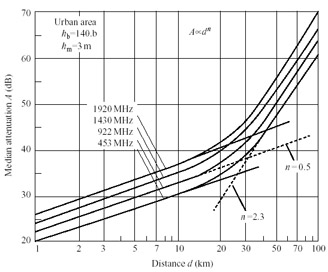
The most extensively used propagation data for mobile communications are still Okumura's measurements from Japan in 1968 (Okumura et al., 1968). The frequencies ranged from 450 to 1900 MHz with variation of antenna heights and terrain type, and a large amount of data was given as graphs showing average path loss. Statistical distributions were also studied with indication of instantaneous Rayleigh fading, and log normal fading for the small sector median values. Figure 4.1.1 is taken from Okumura et al. (1968), and it shows the distance dependency for the smoothed data.


Figure 4.1.1: Example of distance dependence...

UNLIMITED FREE
ACCESS
TO THE WORLD'S BEST IDEAS

SUBMIT
Already a GlobalSpec user? Log in.

This is embarrasing...

An error occurred while processing the form. Please try again in a few minutes.

Customize Your GlobalSpec Experience

Category: Antennas
Finish!
Privacy Policy

This is embarrasing...

An error occurred while processing the form. Please try again in a few minutes.