In the context of Huygens' principle and physical optics, it makes sense to consider a volume over which the phase of contributing waves is fairly constant, centred around the line of sight where the phase is stationary. Consider the situation in Figure D.1 where the distance between the two antennas is d and the total distance to a scattering point is R 1 + R 2.
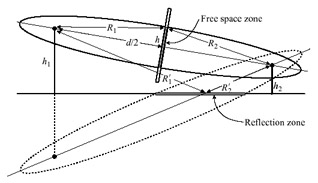 Figure D.1: Definition of the first Fresnel zone for the free space path and for the reflected path. The dotted ellipse is for the reflected path
 Moving on a line perpendicular to the line connecting the two antennas the phase difference increases, and we define the extent of the 'zone of influence' by the points where the excess path length equals l /2,
The higher order Fresnel zones are defined by using multiple values of l /2. Making a transverse cut through the ellipse it is clear that the phase will be fairly constant inside the first Fresnel zone, but that contributions from the higher order zones will tend to cancel due to the phase shifts. This notion gives rise to the first Fresnel zone corresponding to a zone of influence (see also Section 3.1 on reflection from a smooth surface, Section 3.2 on rough surfaces and the discussion in Section 3.3.2 on transition zones).
It is useful to consider the width of the Fresnel zone at the mid point of the ellipse, 2 h, which for...
Copyright The Institution of Electrical Engineers 2003 under license agreement with Books24x7


 TABLE OF CONTENTS