Coaching: Evoking Excellence in Others

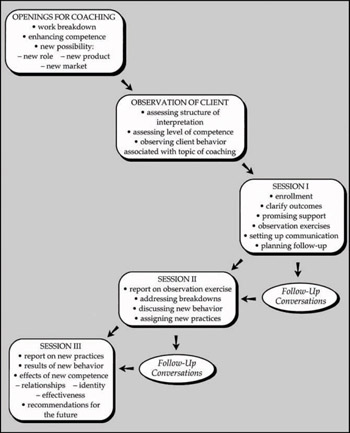
As you will recall, Type Two situations require several conversations (see Figure 9.1). I ll follow the same process as I did with Type One.
During the first conversation, you formally establish the coaching relationship, which means that you request commitment from your client and promise your commitment. Authentic commitment can only happen after you ve honestly confronted potential interruptions to the program s success. The conversation usually begins with a discussion of the opening for coaching that you have observed (see Figure 9.2). Be enrolling and encouraging during this conversation. Remember that your client may be unaware of what you re speaking about. Be prepared to cite examples, to use metaphors, and to describe your observation in different ways.
Once your client expresses some openness or interest, move to a conversation in which you formally establish the coaching relationship. It is important during the enrollment conversation that you establish your credibility with the client. For this to occur, you must be competent to conduct the program, respectful of your client, and skillful in dealing with concerns, questions, or objections your client expresses.
Speak next about ways in which your client can observe what you are talking about. Before you can do this, you must sufficiently understand your client s way of observing. Use one of the assessment models to determine this. It is perfectly fine for the client not to completely understand what you re talking...