Database Tuning: Principles, Experiments, and Troubleshooting Techniques

Learn to improve transferable skills that will facilitate in tuning many database systems on numerous hardware and operating systems.
 TABLE OF CONTENTS
 This chapter discusses tuning considerations having to do with the underlying components common to most database management systems. Each component carries its own tuning considerations.
Concurrency control how to minimize lock contention.
Recovery and logging how to minimize logging and dumping overhead.
Operating system how to optimize buffer size, process scheduling, and so on.
Hardware how to allocate disks, random access memory, and processors.
Figure 2.1 shows the common underlying components of all database systems.
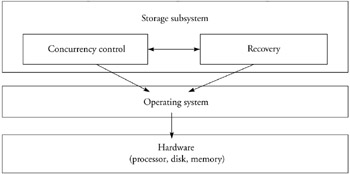
WARNING ABOUT THIS CHAPTER This is the most difficult chapter of the book because we have written it under the assumption that you have only a passing understanding of concurrent systems. We want to lead you to a level where you can make subtle trade-offs between speed and concurrent correctness, between speed and fault tolerance, and between speed and hardware costs.
So, it may be tough going in spots. If you have trouble, take a break and read another chapter.