Database Tuning: Principles, Experiments, and Troubleshooting Techniques

Learn to improve transferable skills that will facilitate in tuning many database systems on numerous hardware and operating systems.
 TABLE OF CONTENTS
 Alberto Lerner, DBA, Doctoral Candidate
DBMSs do not execute SQL queries in the order they are written. Rather, they first capture a query's meaning, translate it into a corresponding access plan, and then execute the set of operations contained in this plan in what you hope is an optimal way given the data structures available. So when you ask something like select C_NAME, N_NAME from CUSTOMER join NATION on C_NATIONKEY = N_NATIONKEY show me all the customers' names and their corresponding nations to an orders database, [1] DB2 would execute instead a plan like the one in Figure D.1. Other DBMSs' explainers would present similar plans though the display would differ a little.
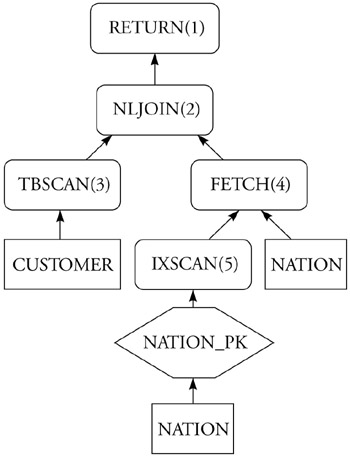
Plans are usually depicted as upward-pointing trees in which sources at the bottom are tables or indexes (squares and diamonds, respectively, in Figure D.1), and internal nodes are operators (octagons). Each operator represents a particular transformation, an intermediate stage in the production of a resulting node.
A plan in fact denotes a complex assembly (or production) line complex because it's an inverted tree rather than a line. "Raw" rows...