Overvoltage Protection of Low-Voltage Systems, 2nd Edition

Extended metal components (e.g., metal roofs and facades, steel reinforcements in concrete, expanded metals in walls, lattices, metal supporting constructions, piping) which form an effective electromagnetic shield (see chapter 4.1.3, Figure 4.1.3.1.3 a) by their meshed interconnection (according to DIN VDE 0800 Part 2, DIN VDE 0185 Parts 1 and 103, DIN VDE 0845 Part 1) are especially important for shielding magnetic fields and for the creation of lightning protection zones.
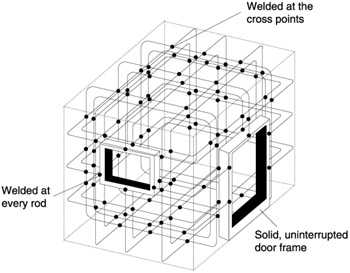
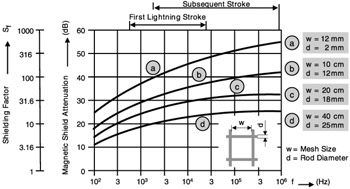
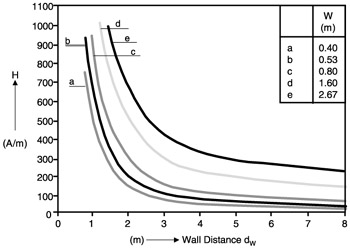
Figure 5.2 a shows how, in principle, a steel reinforcement and the metal window and door frames can form an electromagnetic cage (hole screen). In practice, however, it is not possible to weld or clamp every nodal point for large structures. The achievable shield attenuation or shielding factors of steel reinforcements are shown in Figure 5.2 b for the especially interesting frequency range of lightning interference from 100 Hz to 1 MHz. The damping indicated in this Figure is applicable for the case when a plain magnetic field influences the shield out of steel reinforcement. For estimation of the magnetic field strength at any point inside a lightning current-carrying cage structure, an approximation formula is indicated in the draft of IEC 61312-2. The magnetic field strength depends mainly on the mesh size of the shield and on the distance from the shield (Figure 5.2 c).