Overvoltage Protection of Low-Voltage Systems, 2nd Edition

In systems of great transmission bandwidth and extra sensitive electronic components, apart from the specific use of surge protection devices, circuit parts or component conductor systems will be opened by the insertion of optoelectronic coupling gaps (Figure 5.5 a). Before detailing the application possibilities and limitations of optoelectronic components from the viewpoint of surge protection, these components and devices will be introduced separately as follows.
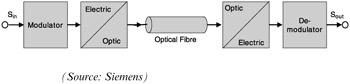
An optoelectronic connection consists of a transmitter, optical fibre and receiver. The transmitter converts an electrical signal into an optical signal which is then transmitted to a receiver by an optical fibre. The optical signal is then converted back to an electrical signal in the receiver. Light-emitting diodes (LEDs) or laser diodes are used in the transmitters. The optical fibre conductors are usually made of glass fibre although plastic fibres are sometimes used. Individual fibres have diameters ranging between 100 and 150 ?m. A single complete conductor can comprise between 10 and 100 fibres. Photodiodes, phototransistors, photothyristors or other photoelectronic devices are used in the receivers. Figure 5.5.1 a shows the principle of an optoelectronic system for data transmission over long distances.
Optical fibre transmission systems have the following advantages over traditional conductor systems: there is no crosstalk between two lines; they have high transmission capacities in a system of low mass; and they are very space-efficient in the...