Overvoltage Protection of Low-Voltage Systems, 2nd Edition

5.7: Isolating Spark Gaps

5.7 Isolating Spark Gaps

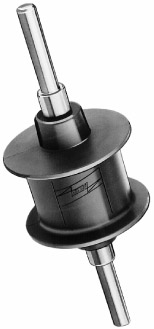
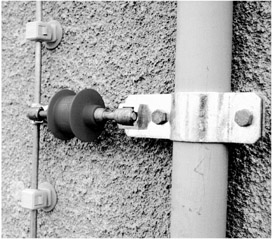
Enclosed spark gaps which can carry test currents of 10/350 ?s (Section 4.5.2 b) without being destroyed are known as isolating spark gaps. Up to their sparkover voltage, these spark gaps provide the electrical separation of two metal installations. Once the nominal spark-over point is reached, they create an electrical bonding path for the lightning current. This coupling is reset after the decay of the lightning current. Isolating spark gaps (Figure 5.7 a) are used at clearances between the lightning protection system and other earthed system parts in order to avoid uncontrolled arcing or puncturing at these points. They are used to incorporate metal installations, for example, into the lightning protection equipotential bonding system in cases where these installations cannot be interconnected due to corrosion effects (Figure 5.7 b).


Figure 5.7 a: Isolating spark gap

Figure 5.7 b: Isolating spark gap for isolating metal systems of different potentials

High specifications must be fulfilled for explosion-protected isolating spark gaps (Figure 5.7 c). These are used to avoid open sparking in the event of a lightning strike in hazardous areas, for example, for bridging the insulation flanges in pipelines. The lightning impulse sparkover voltage 1.2/50 of such spark gaps should be not higher than 50% of the 50 Hz sparkover AC voltage (effective value) of the insulating flange to be protected.


Figure 5.7 c: Explosion-protected isolating spark gap

The impulse sparkover voltage of a spark gap depends on the rate of rise of the generated overvoltage wave.

UNLIMITED FREE
ACCESS
TO THE WORLD'S BEST IDEAS

SUBMIT
Already a GlobalSpec user? Log in.

This is embarrasing...

An error occurred while processing the form. Please try again in a few minutes.

Customize Your GlobalSpec Experience

Category: Gas Discharge Tubes (GDT)
Finish!
Privacy Policy

This is embarrasing...

An error occurred while processing the form. Please try again in a few minutes.