Petroleum Related Rock Mechanics, 2nd Edition

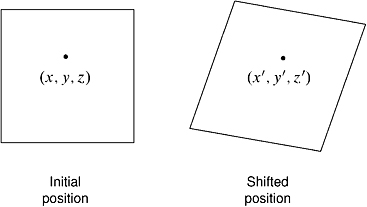
Consider a sample as shown in Fig. 1.11. The position of a specific particle within the sample is initially x, y, z. After the action of an external force, the position of this particle is shifted. We shall denote the shift in x-direction by u, the shift in y-direction by v, and the shift in z-direction by w. The quantities u, v and w are called the displacements of the particle. In order to make the signs of the displacements compatible with the signs of the stresses, as defined in Section 1.1, the displacements are taken to be positive when they are directed in the negative direction of the axes. Hence, the new position of the particle initially at x, y, z becomes
If the displacements u, v and w are constants, i.e. they are the same for every particle within the sample, then the displacement is simply a translation of a rigid body. Another simple form of displacements is the rotation of a rigid body. For a small rotation specified by
, where the magnitude
gives the angle of rotation while the direction of
gives the axis of rotation, the new position of the particle becomes:
where
= ( x, y, z),
? = ( x ?, y ?, z