Petroleum Related Rock Mechanics, 2nd Edition
If the elastic response of a material is not independent of the material s orientation for a given stress configuration, the material is said to be anisotropic. Thus the elastic moduli of an anisotropic material are different for different directions in the material.
Most rocks are anisotropic to some extent. The origin of the anisotropy is always heterogeneities on a smaller scale than the volume under investigation, ranging from layered sequences of different rock types down to molecular configurations. Sedimentary rocks are created during a deposition process where the grains normally are not deposited randomly. For instance, in a river environment, there is a preferred direction (the direction of the streaming water) along which elongated or plane grains will have a tendency to be oriented. Seasonal variations in the fluid flow rates may result in alternating microlayers of fine and coarser grain size distributions. The elastic moduli of rocks created under such conditions will be dependent on the orientation of the material, i.e. they are anisotropic. Due to its origin, anisotropy of this type is said to be lithological or intrinsic.
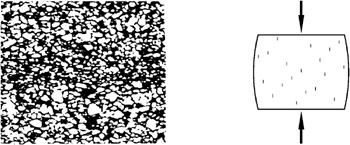
Another important type is anisotropy induced by external stresses. The anisotropy is then normally caused by microcracks, generated by a deviatoric stress and predominantly oriented normal to the lowest principal stress. The microstructure causing the two types of anisotropy is illustrated in Fig. 1.18.
In calculations on rock elasticity, anisotropy is often ignored. This...