Petroleum Related Rock Mechanics, 2nd Edition

When using the first edition of this book as a basis for a course in Petroleum Related Rock Mechanics, we have repeatedly had the request for a refreshment of some mathematical background material, in particular linear algebra. This appendix is an attempt to respond to these requests.
This appendix is not a full tutorial, and we do not attempt to provide full mathematical rigour in the presentation. Still, we hope that this appendix may be useful for readers that need a repetition of some central mathematical methods. We also hope that this appendix may make it easier to read some of the literature in the field.
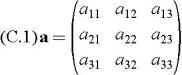
A matrix is a rectangular array of numbers or other mathematical objects. The elements of a matrix are normally referred to by two indices. The first index refers to the rows and the second to the columns.
An example of a 3 3 matrix is thus
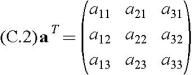
The transpose of a matrix is the matrix found by interchanging the rows and columns of a matrix. The transpose of a is often denoted by a ?. The transpose of the matrix in Eq. (C.1) is
A symmetric matrix is equal to its transpose, i.e. it is left unchanged when reflected about the diagonal:
In component notation this may be written as
A diagonal matrix is a square matrix in which only...