1.4. Strain Energy
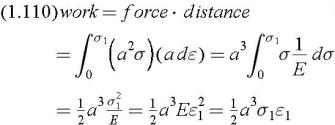
A strained body possesses a potential energy which may be released during unloading. Consider a small cube of a material, with sides a, loaded uniaxially with the stress ?. The resulting elongation is ? = ?/ E. The work done by increasing the stress from 0 to ? 1 is:
where ? 1 = ? 1/ E. As the stress state in this case is uniaxial, ? 1 is a principal stress while ? 1 is a principal strain. When the other two principal stresses are non-zero, corresponding terms will add to the expression for the work. The work per unit volume (= the potential energy per unit volume) then becomes:
W is called the strain energy.
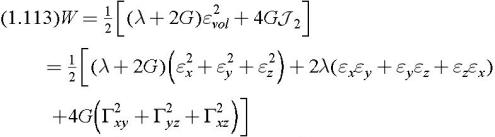
A variety of expressions for the strain energy can be obtained by suitable substitutions for the principal stresses and/or the principal strains. Using Eqs. (1.93) (1.95) to express the stresses in terms of the strains, we find that the strain energy (1.111) is equal to:
Comparing with Eqs. (1.71), (1.72) and (1.73) for the strain invariants, we find that the strain energy may also be expressed as:
Useful relations can be established by analysis of the strain energy. Taking the derivative of Eq. (1.113) with respect to ? x, and using Eq. (1.93), we find that:
Similar expressions connecting ? y to ? y, etc. can also be established in the same way. We now...

 TABLE OF CONTENTS