In this chapter models for target, clutter, jammers and noise are derived which form the basis for the numerical evaluations carried out in the subsequent chapters. To some extent we follow the derivation by VAN TREES [508, pp. 238].
Based on such models ROMAN et al. [440] developed state variable models which indicate that multichannel models of low order can represent airborne ground clutter effectively. This will be confirmed by the results obtained in Chapters 5, 6, 7, and 9. These chapters deal with order-reducing subspace techniques for clutter rejection with real-time capability.
2.1 Transmit and receive process
Let us assume that the radar transmits a signal of the form
where ? c = 2 ? f c denotes the carrier frequency,  being the transmitted power, and E( t) is the envelope of the transmitted waveform for which we assume
Assuming an ideal point-shaped reflector at distance R t from the radar the received signal becomes
where  includes the transmit power and the two-way propagation and reflection processes according to the radar range equation (for details see SKOLNIK [467, pp. 2-1, ...,2-73], [468, pp. 2-1, ...,2-68]). ? is the round-trip delay of the transmitted wave between radar and target
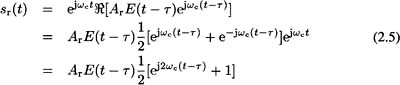
where c is the velocity of light. The received signal then undergoes a complex demodulation which can be described simply by
The high-frequency term will be suppressed by a low-pass filter and the factor of 1/2 can be incorporated in the...
Copyright The Institution of Electrical Engineers 2002 under license agreement with Books24x7


 TABLE OF CONTENTS