Principles of Space-Time Adaptive Processing

In the previous chapters several space-time processing algorithms were presented which are capable of adaptive real-time processing. In this chapter some consideration on space-frequency domain processing [1] are made. We discuss a total of five different processing schemes. Some of them are variants of the space-time processors described in Chapters 5, 6, and 7. All processors presented will be compared in terms of performance. A comparison in terms of computational complexity will be presented in Chapter 15. WRIGHT and WELLS [563] compare pre-Doppler and post-Doppler architectures for application with space-based radar.
The near-optimum techniques described in the previous chapters have been derived from the optimum receiver (1.3), which in essence means pre-whitening of the clutter component in the received echo signals and matching to the desired target signal. It has been shown in Section 1.2.6 that the optimum test can be formulated in the frequency domain as well as in the time domain. Now we have to extend this concept to space-time vector quantities.
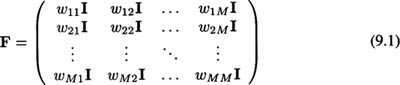
The discrete Fourier transform can be written as a unitary matrix F. Since we want to transform from time to frequency while not changing the space dimension the space-time Fourier transform becomes
where I is the spatial N N unit matrix. [2] The coefficients w nm are given by (1.94)
By similarity transform the clutter covariance matrix Q becomes a power spectral matrix
and the space-time vectors of the desired target...