Propulsion Systems for Hybrid Vehicles

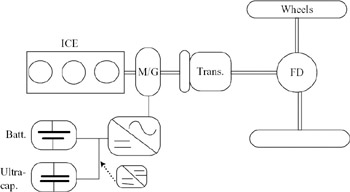
An electric machine is at the core of hybrid propulsion regardless of whether or not the vehicle is gasoline electric, diesel electric or fuel cell electric. Propulsion is via an ac drive system consisting of an energy storage unit, a power processor, the M/G and vehicle driveline and wheels. Figure 4.8 is a schematic of the hybrid propulsion system in a multi-converter architecture. The system in Figure 4.8 can be upgraded by the addition of an interface converter (e.g. booster) to the ultra-capacitor bank for maximum performance when non-alkaline electrolyte storage batteries are used. For example, a lead acid battery system benefits the most from a converter interface to an ultra-capacitor bank. In that case the total energy storage system weight and cost are minimised. With alkaline electrolyte advanced batteries the benefits of adding an ultra-capacitor begin to diminish and with lithium ion the benefits are minimal [4].
The motor-generator, M/G, is sized as follows: maximum input speed at transmission is restricted to <12 000 rpm from the engine side by the rev-limiter function in the electronic engine controller and on the transmission side by the proper gear selection. It is possible to over-speed the M/G and engine by improper downshifting of the transmission while at highway speeds.
Most electric machines rated for vehicle traction applications are limited to 12 000 rpm for several inherent reasons: rotor burst limits, rotor position sensing encoders and their attendant digital interface, bearing system, and critical speeds...