Propulsion Systems for Hybrid Vehicles

In vehicle and outside of the vehicle communications are fast growing technology areas in automotive applications. Automotive communications networks have typically used LANs (local area networks) of the controller area network (CAN) variety. The GM Hywire concept vehicle, for example, is advertized as a completely x-by-wire architecture, but CAN networks are converting over to protocols that are more fault tolerant and have guaranteed communications times and no issues with message latency as has been common for multiple access collision detection (MA/CD) protocols in the past. Time triggered protocols (TTP) have been proposed for many years and are now beginning to enter the automotive arena as a new protocol derived from a TTP/C basis known as Flexray.
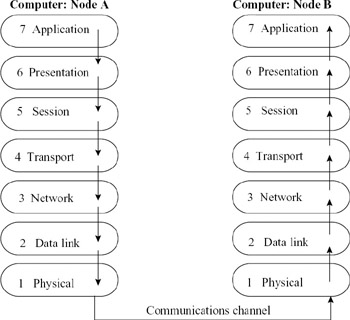
To understand automotive communications it is important to understand the basics of networked communications. In 1983 the Open Systems Interconnection (OSI) committee of the International Standards Organisation (ISO) developed a layered model to describe how two different computer systems may share files with each other over a common network. This OSI model became the industry standard, 7-layered network functionality, open architecture network used universally. Open architecture means that once defined the standard is open to the world to use and build systems that meet the interface definition without the need for patents or licensing. Closed architectures are proprietary, their message format and protocol not accessible, and expansions and enhancements generally costly.
In the OSI 7 layer model shown in Figure 4.41 the network architecture is clearly defined and published.