Propulsion Systems for Hybrid Vehicles

Development of hybrid propulsion systems requires knowledge of the vehicle attributes in terms of mass, frontal area, tyre rolling radius and rolling resistance, plus its aerodynamic drag coefficient. The accepted procedure for obtaining these data comes from vehicle coast down testing. This chapter illustrates the coast down process on two very different vehicles seen often on highways in North America and Europe: the sport utility vehicle and tractor-trailors (semis).
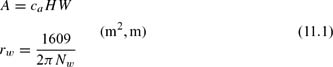
Before engaging in coast down testing it is necessary to know the vehicle mass, frontal area and tyre rolling radius. The procedure to obtain these data, if not known from manufacturers' specifications, is to weigh the vehicle, and calculate the frontal area and tyre rolling radius according to (11.1):
where the vehicle track, W, and height from ground to roof, H, are used to approximate the frontal area. The factor c a (~0.9) is a coefficient in (11.1) to make provision for nominal ground clearance and aerodynamic styling (body contours). The tyre rolling radius is best obtained by noting the number of revolutions made per set distance, such as a kilometer or mile. In (11.1) the number of tyre revolutions per mile is used to compute the dynamic rolling radius on the road surface for which the vehicle attributes are being evaluated. The static rolling radius has been described earlier in this book, and will be compared here to dynamic rolling radius to validate the factor of 0.95 to 0.99 used in that discussion. The procedure for...