Ship Construction, Sixth Edition

Originally ships were constructed with single bottoms, liquid fuels and fresh water being contained within separately constructed tanks. The double bottom structure which provides increased safety in the event of bottom shell damage, and also provides liquid tank space low down in the ship, only evolved during the early part of the twentieth century. Today only small vessels such as tugs, ferries, and cargo ships of less than 500 gross tonnage have a single bottom construction. Larger ocean going vessels are fitted with some form of double bottom.
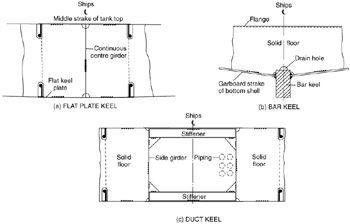
At the centre line of the bottom structure is located the keel, which is often said to form the backbone of the ship. This contributes substantially to the longitudinal strength and effectively distributes local loading caused when docking the ship. The commonest form of keel is that known as the 'flat plate' keel, and this is fitted in the majority of ocean-going and other vessels ( see Figure 16.1(a)). A form of keel found on smaller vessels is the bar keel (Figure 16.1(b)). The bar keel may be fitted in trawlers, tugs, etc., and is also found in smaller ferries.
Where grounding is possible this type of keel is suitable with its massive scantlings, but there is always a problem of the increased draft with no additional cargo capacity. If a double bottom is fitted the keel is almost inevitably of the flat plate type, and bar keels are more often associated with open floors, but...