Ship Construction, Sixth Edition

Chapter 21: Aft End Structure

Overview

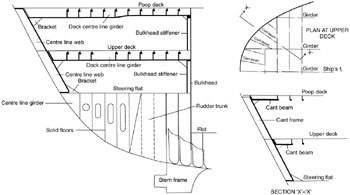
Considerable attention is paid to the stern in order to improve flow into and away from the propeller. The cruiser stern ( see Figure 21.1) was for many years the favoured stern type for ocean going ships, but today most of these vessels have a transom stern ( see Figure 21.2). A cruiser stern presents a more pleasant profile and is hydrodynamically efficient, but the transom stern offers a greater deck area aft, is a simpler construction, and can also provide improved flow around the stern. It is interesting to note that the Queen Mary 2 has a combined stern the upper part being of cruiser stern form for seakeeping and the lower part being of transom form for efficient hydrodynamics.


Figure 21.1: Cruiser stern

Figure 21.2: Transom stern

Many forms of rudder are available and the type and form fitted is intended to give the best manoeuvring characteristics. Both the shape of the stern and the rudder type will dictate the form of the stern frame, and this will be further influenced by the required propeller size. Of particular importance at the after end are the arrangements which permit both the propeller shaft and the rudder stock to pierce the intact watertight hull. The safety of the ship may depend on these arrangements. Where more than one screw propeller is to provide the thrust required to propel the ship, bossings or 'A' brackets will be fitted to support the outboard shafts. Whilst most ships are...

UNLIMITED FREE
ACCESS
TO THE WORLD'S BEST IDEAS

SUBMIT
Already a GlobalSpec user? Log in.

This is embarrasing...

An error occurred while processing the form. Please try again in a few minutes.

Customize Your GlobalSpec Experience

Category: Navigation Lights
Finish!
Privacy Policy

This is embarrasing...

An error occurred while processing the form. Please try again in a few minutes.