Short-Circuit Currents

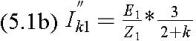
The theoretical approach to calculate short-circuit (s.-c.) currents with symmetrical components in general and especially in the case of single-phase short-circuit was explained in detail in Chapter 2. Current and voltages in case of short-circuits with earth connection (e.g., single-phase short-circuits) depend on the positive- and zero- sequence impedances Z 1 and Z 0. If the ratio of zero-sequence to positive-sequence impedance is k = Z 0/ Z 1 the voltages in the non-faulted phases (see Equation (2.25a)) and the single-phase short-circuit current (see Equation (2.25b)) are
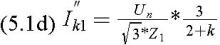
If the voltage E 1 is set to E 1 = U n/ ?3, similar to the equivalent voltage at short-circuit location then
The impedances in the positive-sequence (and negative-sequence) system are determined only by the network topology. The single-phase short-circuit current and the voltages of the non-faulted phases can be changed only by changing the ratio of positive-sequence to zero-sequence impedance, i.e., by changing the handling of transformer neutrals.
The type of neutral earthing determines the impedance Z 0 of the zero-sequence component and has a dominating influence on the short-circuit current through earth, i.e., I ? k1 in case of single-phase short-circuits and I ? kE2E in case of two-phase short- circuit with earth connection. In order to change the zero-sequence impedance of the system, it is possible to earth any number of neutrals, i.e., none, a few or all transformer neutrals, leading to the highest zero-sequence...