Short-Circuit Currents

Low-impedance earthing is applied in medium-voltage and high-voltage systems worldwide with nominal voltages above 10 kV. Power systems having nominal voltages U n ? 132 kV are generally operated with low-impedance earthing. In order to realise a power system with low-impedance earthing, it is not necessary that the neutrals of all transformers are earthed, but to fulfil the criteria, that the voltages of the non-faulted phases remain below 140 per cent of the nominal system voltage in the case of a single-phase short-circuit. The disadvantage while earthing all neutrals is seen in an increased single-phase short-circuit current, sometimes exceeding the three-phase short-circuit current. The neutral of unit transformers in power stations shall not be earthed at all, as the single-phase short-circuit current will then depend on the generation dispatch. As the contribution of one unit transformer is in the range of up to 8 kA, the influence on the single-phase short-circuit currents is significant.
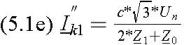
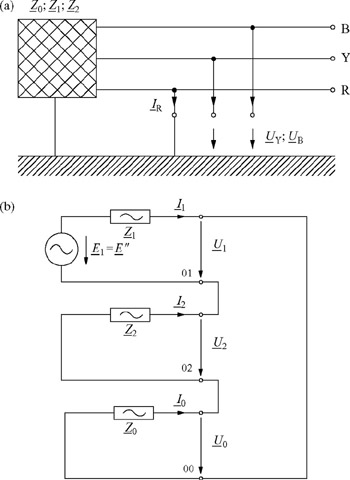
Based on Figure 5.1 and assuming a far-from-generator short-circuit with positive- sequence impedance equal to negative-sequence impedance Z 1 = Z 2, the single- phase short-circuit current is calculated by
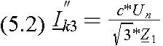
with voltage factor c according to Table 4.1. If the single-phase short-circuit current is related to the three-phase short-circuit current
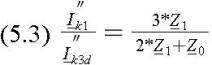
it follows that
The relation of single-phase to three-phase...