Short-Circuit Currents

The operation of power systems with isolated neutrals is applicable to systems with nominal voltages up to 60 kV, however the main application is seen in power station auxiliary installations and industrial power systems with voltages up to 10 kV. In public supply systems, isolated neutrals are not very common.
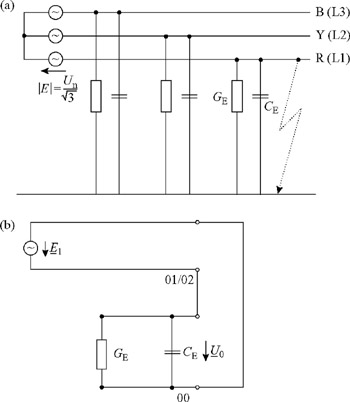
The analysis of a single-phase earth-fault is based on Figure 5.6.
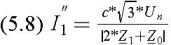
Contrary to power systems with low-impedance earthing or earthing with current limitation the capacitances phase-to-earth capacitances in the zero-sequence component cannot be neglected in power systems with isolated neutral as can be seen from Figure 5.6. To determine the respective parameters of the equipment, no-load measurements are necessary. The single-phase earth-fault current, in general, is calculated by
where U n is the nominal system voltage, c is the voltage factor as per Table 4.1 and Z 1; Z 0 are the positive- and zero-sequence impedances, respectively.
The zero-sequence impedance Z 0 is determined by the capacitance phase-to-earth C E, and is significantly higher than the positive-sequence impedance Z 1. The single-phase earth-fault current is determined through the capacitive component by
and is called capacitive earth-fault current I CE. As the capacitive earth-fault current is significantly lower than a typical short-circuit current, in most of the cases even lower...