Over the years manufacturers have developed many generic forms of solid/liquid separator. The need to compete in the marketplace and gain a competitive edge, however, has led manufacturers to develop a plethora of variants. Rather than detailing all of these variants, this chapter attempts to give a descriptive overview of the generic equipment types and the main alternatives available to the design engineer (see Figure 1.1). The advantages and disadvantages of equipment are highlighted and an effort has been made to provide quantitative values whenever possible. More guidance values for the operational parameters of filters are shown in Appendix A, while greater details of recent developments in several equipment types are presented in Wakeman and Tarleton (2005b). In addition to the more specific references given throughout this chapter, the interested reader is also referred to the texts by Dickenson (1997), Kirk-Othmer (1980), Matteson and Orr (1987), Perry and Green (1984), Purchas (1981), Purchas and Wakeman (1986), Rushton et al (1996), Svarovsky (1990), Schweitzer (1997) and Wills (1992).
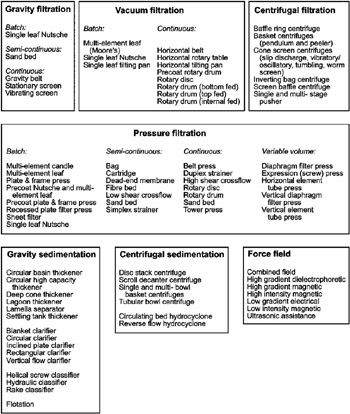 Figure 1.1: Broad classification chart showing the forms of solid/liquid separator described in this chapter.
 General descriptions and typical equipment uses are shown under each main heading in addition to the solids concentration and particle size found in a typical feed. The process ratings used in the Filter Design Software (FDS) package are described in Chapter 5. The ratings give relative values between 0 and 9 for cake dryness (and state), washing performance, liquid product clarity and crystal breakage, where...
Copyright Elsevier Ltd. 2007 under license agreement with Books24x7


 TABLE OF CONTENTS