Solid/Liquid Separation: Equipment Selection and Process Design

6.3: Design Equations for Centrifugal Filter Cycles

6.3 Design Equations for Centrifugal Filter Cycles

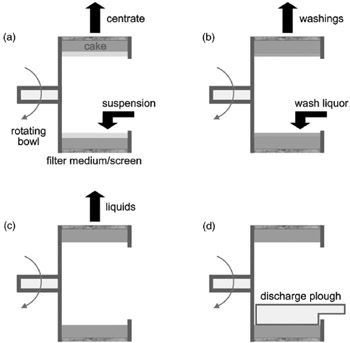
Although the main purpose of this chapter is to present design procedures for batch filter cycles, the methodologies described can be adapted to the operations performed in a batch centrifuge and by way of example Figure 6.10 illustrates a typical peeler centrifuge cycle. During the filtration of a suspension batch, the perforated basket covered by a filter cloth is rotated at a constant speed and the induced centrifugal forces cause the centrate to pass leaving the filtered particles to form the cake. Following the completion of cake formation, the cake may subsequently be washed by sprays and/or allowed to deliquor prior to discharge by mechanical plough or peeler. With centrifugal filters the filtration area is a function of time and for a peeler centrifuge the equation relating filtrate flow rate ( q) to cake growth is


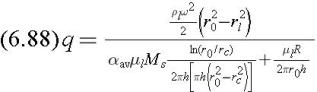
where ? is the angular velocity of the basket, r 0 the inner radius of the basket, r l the radius of the liquid layer, r c the inner radius of the cake and h the basket depth. Noting that the average flow area ( A f) av = ?h( r 0 + r c) and the logarithmic mean flow area ( A f) lm = 2 ?h( r 0 ? r c)/ln ( r 0/ r c), equation (6.88) may be rewritten as


Figure 6.10:

UNLIMITED FREE
ACCESS
TO THE WORLD'S BEST IDEAS

SUBMIT
Already a GlobalSpec user? Log in.

This is embarrasing...

An error occurred while processing the form. Please try again in a few minutes.

Customize Your GlobalSpec Experience

Category: Filtration Equipment
Finish!
Privacy Policy

This is embarrasing...

An error occurred while processing the form. Please try again in a few minutes.