Solitons in Optical Fibers: Fundamentals and Applications
3.2: Optical Amplifiers

3.2 Optical Amplifiers

3.2.1 The Raman Effect and Raman Amplification

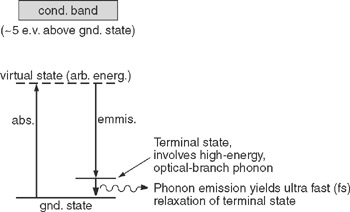
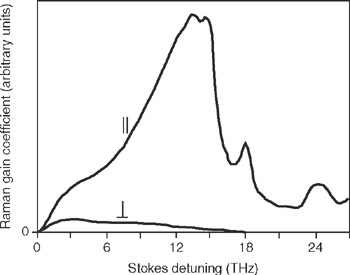
The Raman effect in silica-glass fibers begins with a pump-induced transition to a virtual state, followed by emission from it, where the emission terminates on an excited state of the lattice; emission of an optical phonon (which typically takes place within a few femtoseconds) then completes return to the ground state (see Fig. 3.3). Because of the extremely fast relaxation, the population of the terminal state of the optical emission tends to be determined by equilibrium with the surrounding phonon bath, and hence is almost independent of the rates of optical pumping and emission. Thus, in contrast to erbium amplifiers, both the shape of the Raman gain band (see Fig. 3.4) and the excess spontaneous emission factor are essentially independent of pump and signal levels.


Figure 3.3: Optical transitions of the Raman effect.

Figure 3.4: Relative strength of Raman gain versus the frequency difference between pump and signal photons. The parallel and perpendicular symbols refer to co-polarized and orthogonally polarized pump and signal, respectively. Reproduced with permission of Dougherty et al. [ [46]].

For gain in the neighborhood of the very broad peak of the Raman gain band, and when the fiber is at or near room temperature, the excess spontaneous emission factor n sp ? 1.1 (noise figure ? 3.5 dB). Nevertheless, Raman gain is prized more than anything else, for the great noise reduction afforded (as will be detailed shortly) by its ability to...

UNLIMITED FREE
ACCESS
TO THE WORLD'S BEST IDEAS

SUBMIT
Already a GlobalSpec user? Log in.

This is embarrasing...

An error occurred while processing the form. Please try again in a few minutes.

Customize Your GlobalSpec Experience

Category: Fiber Optic Amplifiers
Finish!
Privacy Policy

This is embarrasing...

An error occurred while processing the form. Please try again in a few minutes.