Solitons in Optical Fibers: Fundamentals and Applications

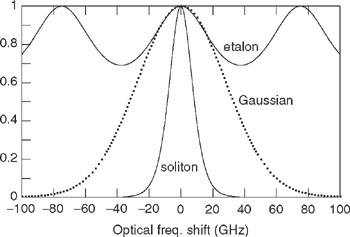
In mid-1991, two groups independently suggested the idea that the Gordon-Haus jitter and other noise effects could be significantly suppressed in soliton transmission systems simply through a narrowing of the amplifier gain-bandwidth [ [65], [66]]. In practice this means the use of narrow-band filters, typically one per amplifier. Figure 3.28 shows appropriate filter response curves in comparison with the spectrum of a 20-ps-wide soliton. The fundamental idea is that any soliton whose central frequency has strayed from the filter peak will be returned to the peak, in a characteristic damping length ?, by virtue of the differential loss the filters induce across its spectrum. The resultant damping of the frequency jitter leads in turn to a corresponding damping of the jitter in pulse arrival times. For example, in Eq. (3.35) for the variance of the Gordon-Haus jitter, when guiding filters are used, the quantities z 2 n in the sum are all replaced with the common factor ? 2. Thus, the factor Z 3/3 in the final expression is replaced by the (potentially much smaller) factor Z ? 2.
The filters also cause a reduction in amplitude jitter. Consider, for example, a pulse with greater than normal power;